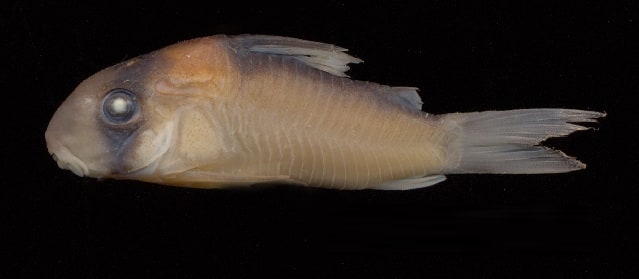
Photo: Claudio de Oliveira, Laboratório de Biologia e Genética de Peixes - UNESP - Botucatu, CC BY 3.0

Should I buy it?
Adolfoi cory
Corydoras adolfoi
Also known as: adolfo's cory, adolfoi corydoras
A striking orange-and-black cory with a vivid dorsal saddle. Needs soft water to show full colour and a school of six on fine sand.
Adolfoi cory tank mates · Fish for 80-litre tanks
First fish: Good · Temperament: peaceful · Daily care: intermediate
Sources & confidenceEvidence: high. Partly checked.
Checked against several solid care sources that mostly agree. The numbers here are a starting point; your water and tank decide the rest. How Fishori checks its data.
Best for: Soft-water planted community tanks 80L or more with sand substrate and a school of six.
Avoid if: Hard alkaline tap water or sharp coarse substrate.
Watch for this
Parking adolfoi cories in hard alkaline tap water because the community is ‘easy tropical’ is how keepers wash out the orange-and-black pattern and invite stress infections. They want soft, acidic-leaning water and a real school of six — not a hard livebearer kit with three mixed cory species.
Top things that go wrong
- Keep a group, not a single fish. Plan at least 6 together.
- Shrimp & snails. Cherry shrimp and other dwarfs can coexist with peaceful small fish; baby shrimp are food for almost anything that finds them.
Worth knowing before you buy
- 1.Myth: adolfoi cories are hardy tropical cleanup crew for any tap-water community. Reality: they need soft water, sand, and a real same-species group — hard alkaline kits fade the colour and the fish long before the algae problem is solved.
- 2.Bought in pairs to save money. Undergrouped adolfois stress and lose colour fast.
- 3.Kept in hard cold water. The black cap fades to grey within weeks.
- 4.Sand, frequent water changes, and a varied high-quality food rotation beat 'generic flake on the glass' for long-term snout and barbel health.
About this species
Adolfoi corys carry a bold black cap from snout to dorsal fin on a white body. Most shop fish are still wild-caught from blackwater Brazil, so source responsibly. Needs soft warm oxygenated water and a school of six to show natural play behaviour.
- Glass Catfish80L min · same group, comparable tank size
- Peppered Corydoras80L min · same group, comparable tank size
- Bronze corydoras100L min · same group, similar adult size
- Corydoras CatfishTank size not confirmed · same fish family
- Julii Corydoras60L min · same group, similar adult size
- Panda Corydoras60L min · same group, similar adult size
- Salt and pepper cory / dwarf cory60L min · same group, similar adult size
- Sterba's Corydoras100L min · same group, similar adult size
- Bamboo Shrimpalso intermediate peaceful, similar tank size
- Black ruby barbalso intermediate peaceful, similar tank size
- Brown / hockey-stick pencilfishalso intermediate peaceful, similar tank size
- Cardinal Tetraalso intermediate peaceful, similar tank size
- Celebes Rainbowfishalso intermediate peaceful, similar tank size
- Checkerboard cichlidalso intermediate peaceful, similar tank size
No reverse lookups listed yet.
Plan grid
Key limits are above. Here: pH band, swim level, and activity.
Swim zones
Care snapshot
Quick compare before you buy. Not a score of how “good” the fish is.
- Beginner easeCare level, tank demand, water window
- PeacefulnessTemperament, nipping, predation flags
- Community fitSafe-mate breadth & aggression load
- Small-tank fitFrom the published minimum volume: 100 = ~20 L or less; each doubling of the minimum scores lower
- HardinessCare tier & parameter tolerance
- EnergyActivity guide in this profile
Before you add tank mates
Keep at least 6. The published minimum is 80 litres. Check each name before you buy. The names are not one tank to set up.
Usually kept with Ember Tetra, Neon Tetra.
Compatibility
Tank mates for Adolfoi cory
Usually kept together: Ember Tetra, Neon Tetra. Needs specific conditions (CAUTION): Angelfish, Bala / silver shark, Chili Rasbora, Dwarf pencilfish, German Blue Ram. Do not keep with (RISKY): African Cichlid, Guppy, Oscar. The names are not one tank to set up.
Usually kept together
Only with a condition
Open the pair page. It states the condition for keeping them together.
Usually avoid
Pairings the pair checker marks RISKY.
Compare with
Run a real pair check: Adolfoi cory + Ember Tetra
- Try Ember Tetra — open the pair check.
- Try Neon Tetra — open the pair check.
Behaviour and temperament
Adolfoi cories are peaceful bottom schoolers that spend the day working sand and leaf litter. They ignore midwater fish and fail when kept as a trio on gravel in hard water. Stress shows as frantic glass swimming or resting clamped when the school is too small or the substrate is sharp.
What sets them off
- Sudden crowding
- Poor water quality
Fin nipping: Not a habitual fin-nipper; stressed or crowded individuals can still test fins.
Predation: Not a predator toward similarly sized community fish; fry and dwarf shrimp are still fair game for most species.
Territory: Not strongly territorial, but still needs room so its working space does not overlap the next fish.
Planted tanks: excellent — easy plant ideas
In the glass: typical and warning signs
- A group of six or more works soft sand together after lights soften.
- Barbels stay clean and busy on sand; gravel shreds them over months.
- Washed-out orange in hard alkaline water is chemistry before brand of food.
- Frantic glass pacing in a trio usually means more of their own kind first.
- None toward tank mates; competition is over sinking wafers inside the group.
- They lose to predatory cichlids and get outcompeted by frantic midwater feeders.
- Move them out of hard-water livebearer plans that will not be rewritten.
- Increase group size before adding another bottom species to ‘keep them company.’
Water, food, and grouping
Hardness
soft
Diet
omnivore
Adolfoi cories are bottom omnivores that need sinking wafers and frozen foods after the midwater rush. Leftover flake on the glass is not a feeding plan. Drop food to soft sand, confirm the slowest fish eats, and keep a group so competition at one wafer does not leave weaker cories empty.
Shrimp & snails
Cherry shrimp and other dwarfs can coexist with peaceful small fish; baby shrimp are food for almost anything that finds them.
Schooling species — buy 6+ together. Smaller groups stress and lose colour.
- Hold 22 to 26 °C steadily on a real thermometer, not the dial on the heater.
- Aim for pH 5.5 to 6.5 and a hardness you can re-test in two weeks. A one-time strip in the shop car park is not a water test.
- Schooling species. Buy 6 or more from the same tank on the same day before adding any centrepiece fish.
- Tank volume meets or exceeds 80L published minimum for adults.
- You can stock at least 6 individuals (group welfare).
- Heater can hold 22–26°C without cooking cooler-water tank mates.
Related pages
Tank mates, care guides, and tanks around this minimum.
Plan with tools
Check a tank mate as a pair, or plan the whole tank with this fish in the builder.
Filtration & heating
Fishori rule of thumb, not a requirement for this species: a filter rated at roughly four times the tank volume per hour, about 320 L/h for the 80 L minimum. Box ratings are measured with little media in place, and fish that want gentle flow need the outflow softened. Use a heater that holds 22–26°C reliably.
Plant suggestions
Adolfoi cory does well in planted tanks. Plants compatible with 22–26°C and pH 5.5–6.5:
Research: partially verified · Confidence: high · 3 linked source(s). We do not invent citations.
How Fishori evaluates compatibility (same logic as pair and tank tools).
- Seriously Fish. Corydoras adolfoi
Care sheet for size, water, behaviour and tank mates.
- FishBase. Corydoras adolfoi
Secondary: taxonomy, distribution, and maximum length in nature; cross-check with aquarium import lines and measured tank parameters.
- Wikipedia. Corydoras adolfoi
Secondary: general species context; verify all husbandry numbers against a dedicated aquarium care sheet and your test kit, not a single table row.
Evidence notes
- The Seriously Fish profile for the binomial in this record was successfully reached as the primary aquarium reference.
- FishBase contributes natural-range size and habitat context. Translate those numbers through your heater, your water report, and your tank footprint before stocking.
- Wikipedia is only cited if the article URL returned OK. Use it for orientation, not as the only care sheet for an import.
- All compatibility text reflects typical hobby experience and the Fishori model. Individual fish, shop stress, and the order tank mates are added in can still defy a single-paragraph label.
Common questions about Adolfoi cory
- How big do Adolfoi cory get?
- Adolfoi cory adults reach about 5 cm. Shop fish look smaller; stock for the adult length.
- What size tank does Adolfoi cory need?
- Needs 80 L. Adults reach about 5 cm and stay mostly near the bottom, in a school.
- Are Adolfoi cory aggressive?
- Adolfoi cories are peaceful bottom schoolers that spend the day working sand and leaf litter. They ignore midwater fish and fail when kept as a trio on gravel in hard water. Stress shows as frantic glass swimming or resting clamped when the school is too small or the substrate is sharp.
- Do Adolfoi cory need to be kept in a group?
- Schooling species — buy 6+ together. Smaller groups stress and lose colour.
- What is the most common mistake with Adolfoi cory?
- Parking adolfoi cories in hard alkaline tap water because the community is ‘easy tropical’ is how keepers wash out the orange-and-black pattern and invite stress infections. They want soft, acidic-leaning water and a real school of six — not a hard livebearer kit with three mixed cory species.
- What fish can live with Adolfoi cory?
- Usually kept with Adolfoi cory: Ember Tetra, Neon Tetra. Angelfish, Bala / silver shark, Chili Rasbora, Dwarf pencilfish are conditional (CAUTION): workable only with the specific conditions on each pair page. Avoid African Cichlid, Guppy, Oscar (RISKY). Check the exact pair, with your tank size, before you buy.