Should I buy it?
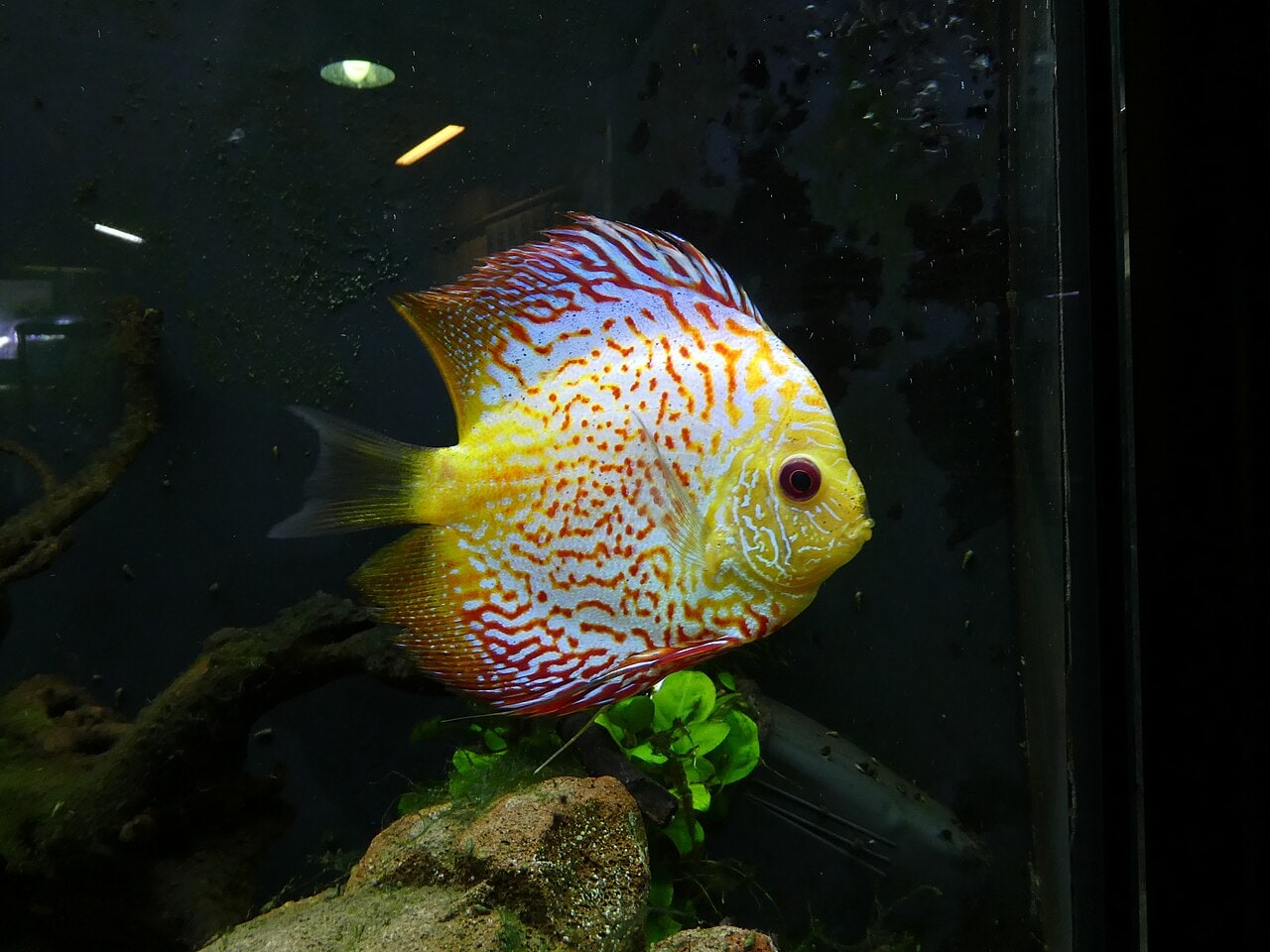
Discus
Symphysodon sp.
Also known as: pompadour fish
Advanced keeper's fish. A discus group in a well-run soft-water tank rewards the effort, but discus do not forgive casual maintenance or impulse stocking.
Discus tank mates · 200L tank size hub
peaceful · advanced care
Sources & confidencehigh · verified · beginner: not recommended
Checked against several solid care sources that mostly agree. Numbers here are a careful starting point. Your tap water, tank size, and habits decide the rest. How we evaluate.
Best for: Experienced keepers running soft-water planted tanks of 250 L or more with daily attention and regular water changes.
Avoid if: You have kept fish for less than a year. You can't do 30% or more water changes weekly. Or your water is hard.
Common mistakeRunning large water changes with temperature-mismatched water is the classic discus wipeout. A few degrees colder on a big change triggers disease in otherwise healthy fish. Match temperature and chemistry on every change, and do not start discus on hard tap water you will not soften.
Top things that go wrong
- Specialist husbandry. Keep at least 4, bought at the same time.
- Shrimp & snails. Cherry shrimp and other dwarfs can coexist with peaceful small fish; baby shrimp are food for almost anything that finds them.
What most shops don't tell you
- 1.Myth: discus are just fancy community cichlids for any planted 200L. Reality: they need warm soft water, a real group, and obsessive change discipline — hard tap and mixed tropical chemistry erase them faster than a missing decoy fish ever will.
- 2.Large minimum volumes still need real footprint: length and width for turning matter as much as the litre number on a sticker.
- 3.First tank, first week, 100 L with six random discus 'because the shop had a deal' is the classic crash recipe.
- 4.Slotting a discus into a cory plus neon plus barb 'community' tank without growth and water-change math.
- 5.Not suitable for beginners. Discus require precise water conditions, high temperatures, and frequent water changes. Tank mates must tolerate 28 to 30 °C.
- 6.Discus need very warm, soft water and excellent maintenance — not a first fish.
About this species
Discus are tall disc-shaped South American cichlids that need 28 to 32 °C, soft acidic water, and clean conditions. Adults reach 15 to 18 cm and need vertical space, not just litres.
- African Cichlid200L min · same group, comparable tank size
- Convict cichlid200L min · same group, comparable tank size
- Firemouth Cichlid200L min · same group, comparable tank size
- Keyhole cichlid200L min · same group, comparable tank size
- Rainbow cichlid200L min · same group, comparable tank size
- Angelfish150L min · same group, similar adult size
- Electric Blue Acara150L min · same group, similar adult size
- Severum250L min · same group, similar adult size
- Hillstream Loachalso advanced peaceful, similar tank size
- Ropefish / reed fishalso advanced peaceful, similar tank size
- Sterba's Corydoras tank matesnames this fish as a conditional pairing — read the pair page conditions
Plan grid
Key limits are above. Here: pH band, swim level, bioload, and activity.
Swim zones
Care snapshot
Quick compare before you buy. Not a score of how “good” the fish is.
- Beginner ease29
- Peacefulness90
- Community fit65
- Small-tank fit34
- Hardiness31
- Energy54
Numbers are deterministic planning indices from Fishori fields — not a scientific score of your individual fish.
Example setups
Starting points only. Run the pair checker for every fish you add.
Match temperature and pH overlap with every tank mate, then verify adult size and group rules on pair pages — Fishori is biased toward boring, survivable plans.
Compatibility
Tank mates for Discus
No unconditional “safe” tank mates are listed for Discus — this shortlist has CAUTION pairings that need specific conditions and RISKY pairings to avoid. Conditional (CAUTION — read the pair page before buying): German Blue Ram, Zebra Danio. Avoid (RISKY): Jack Dempsey, Oscar, Tiger Barb. Every name links to a live pair check — the lists are a shortlist, not a stocking plan.
Usually safer
Open a pair page with this fish as the starting point.
None listed. Use the pair checker before mixing.
Needs planning
Read the blocking rule on each pair page before experimenting.
Usually avoid
Do-not-stock combinations on conservative hobby rules.
No safe-mate list on this record yet. Use the fish index to find species with similar care, then run a pair check before you buy.
Behaviour and temperament
Discus are peaceful but socially complex. Kept singly they pine; in pairs they squabble; in groups of six or more they form a stable hierarchy. They ignore robust midwater neighbours that leave them alone and fail when water quality or temperature swings replace husbandry.
What sets them off
- Sudden crowding
- Poor water quality
Fin nipping: Not a habitual fin-nipper; stressed or crowded individuals can still test fins.
Predation: Not a predator toward similarly sized community fish; fry and dwarf shrimp are still fair game for most species.
Territory: Not strongly territorial, but still needs room so its working space does not overlap the next fish.
Planted tanks: excellent — easy plant ideas
In the glass: typical and warning signs
- A group of six or more holds midwater with a clear pecking order and shared feeding.
- Darkened colour after a move often settles once water and temperature stay stable.
- Clamped fins and refusal to eat after a cold water change means temperature shock first.
- A lone discus hanging at the glass usually needs more of its own kind, not another ornament.
- In-group ranking looks rough and is still better than a pair that never settles.
- They rarely shred fins for sport; water failure looks like “aggression” more often than malice.
- Pull discus from any hard-water livebearer plan that will not be rewritten.
- Quarantine new fish before they join a warm, soft show tank — discus punish shortcuts.
Fish behaviour can vary between individuals and tank setups. Always observe new fish closely after introduction.
Water, food, and grouping
Hardness
soft
Diet
carnivore
Discus are warm-water carnivores that need rich, frequent meals — quality discus pellets or frozen mixes several times a day while young, then steadier adult portions. A community flake pinch once a day leaves them thin and invites disease. Feed where the group holds midwater, and keep leftovers from fouling the warm, soft water they demand.
Shrimp & snails
Cherry shrimp and other dwarfs can coexist with peaceful small fish; baby shrimp are food for almost anything that finds them.
Keep at least 4, bought at the same time.
- Hold 28 to 32 °C steadily on a real thermometer, not the dial on the heater.
- Aim for pH 6 to 7 and a hardness you can re-test in two weeks. A one-time strip in the shop car park is not a water test.
- Footprint: short wide tanks and tall narrow tanks fish differently for the same volume. Match the tank shape to the swim pattern, not just the litre count.
- Tank volume meets or exceeds 200L published minimum for adults.
- You can stock at least 4 individuals (group welfare).
- Heater can hold 28–32°C without cooking cooler-water tank mates.
- Filter maturity / stable parameters before adding sensitive stock.
Explore and stocking hubs
Tank-mates hub, matching guides, category peers, and litre stocking lists around this species’ minimum tank.
Plan with tools
Check mates as pairs first, then add this fish in the tank builder for the full stocking.
Filtration & heating
A 200L minimum tank needs a filter rated for at least 800L/hr turnover and a heater to hold 28–32°C reliably.
Plant suggestions
Discus does well in planted tanks. Plants compatible with 28–32°C and pH 6–7:
Research: verified · Confidence: high · 3 linked source(s). We do not invent citations.
How Fishori evaluates compatibility (same logic as pair and tank tools).
- Seriously Fish. Symphysodon aequifasciatus (discus complex representative)
Primary stand-in: Seriously Fish page for a common discus taxon. Trade 'discus' is often a mix of lineages, strains, and hybrids. Match your bag label, not a single name field here.
- FishBase. Symphysodon aequifasciatus
Taxonomy, distribution, and typical max length in natural/wild contexts (cross-check to aquarium import lines).
- Wikipedia. Discus (fish)
Encyclopaedia overview; use specialist aquarium sources for your stock's real temperature/pH/footprint needs.
Evidence notes
- The Seriously Fish profile for the binomial in this record was successfully reached as the primary aquarium reference.
- FishBase contributes natural-range size and habitat context. Translate those numbers through your heater, your water report, and your tank footprint before stocking.
- Wikipedia: used only for stable paths where the binomial or a slug override could be confirmed. Broad trade categories should stay in generic planning mode.
- All compatibility text reflects typical hobby experience and the Fishori model. Individual fish, shop stress, and the order tank mates are added in can still defy a single-paragraph label.
Featured compatibility checks
Curated pair pages for Discus. Each opens a full verdict — not just a list label.
Common questions about Discus
- How big do Discus get?
- 15 to 18 cm disc-shaped. The body shape is the planning issue, not the length. Discus need vertical space.
- What size tank does Discus need?
- 250 L or more for five or six fish (they do not pair off well in small numbers). 50 cm or more tank height matters.
- Are Discus aggressive?
- Discus are peaceful but socially complex. Kept singly they pine; in pairs they squabble; in groups of six or more they form a stable hierarchy. They ignore robust midwater neighbours that leave them alone and fail when water quality or temperature swings replace husbandry.
- What is the most common mistake with Discus?
- Running large water changes with temperature-mismatched water is the classic discus wipeout. A few degrees colder on a big change triggers disease in otherwise healthy fish. Match temperature and chemistry on every change, and do not start discus on hard tap water you will not soften.
- What fish can live with Discus?
- This profile currently has no curated unconditional safe-mates shortlist for Discus. Other species may still return GOOD in the pair checker, so check the exact pair rather than treating this shortlist as exhaustive. German Blue Ram, Zebra Danio are conditional (CAUTION): workable only with the specific conditions on each pair page. Avoid Jack Dempsey, Oscar, Tiger Barb (RISKY). Run the pair checker for your exact water and tank size before stocking.