Should I buy it?
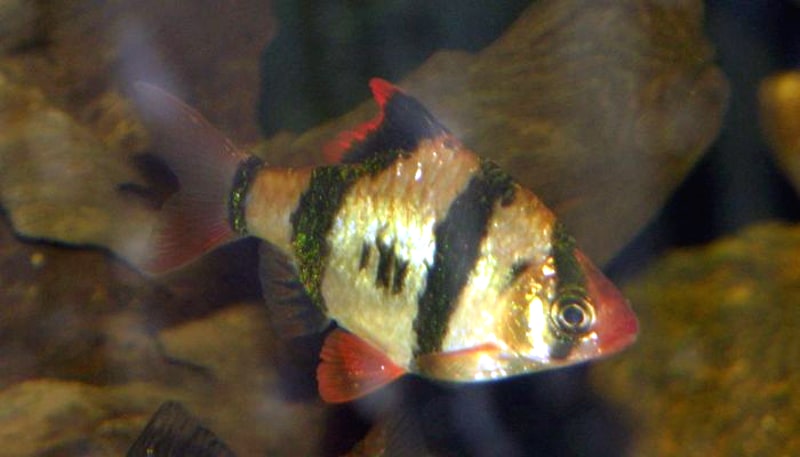
Tiger Barb
Puntigrus tetrazona
Also known as: sumatra barb, tiger (green / albino types)
Notorious fin-nipper, but stable in a group of eight or more. The solo or trio tiger barb is the version that destroys community tanks.
Tiger Barb tank mates · 80L tank size hub
semi-aggressive · intermediate care
Sources & confidencehigh · verified · beginner: caution
Checked against several solid care sources that mostly agree. Numbers here are a careful starting point. Your tap water, tank size, and habits decide the rest. How we evaluate.
Best for: A 100L+ tank where a school of eight to ten can settle into a stable hierarchy.
Avoid if: You already keep long-finned fish (bettas, angels, gouramis, guppies) or want a calm community tank.
Common mistakeKeeping one or two tiger barbs in a 40L is how keepers invent relentless fin-nippers that shred every long-finned neighbour. Eight in adequate length spreads the chaos inside the school. A lonely pair is a harassment machine, not a beginner accent fish.
Top things that go wrong
- Fin-nipping risk in typical community layouts. Will nip long fins or slow fish when the school is too small, bored, or kept in a short tank.
- Group welfare — not a solo display fish. Plan at least **8** together for normal behaviour; smaller groups often mean stress, colour loss, or nipping depending on species.
- Shrimp & snails. Shrimp are a gamble with this fish; some ignore them, some clear a colony in days.
What most shops don't tell you
- 1.Myth: tiger barbs are fine as one or two lively accents in any community with long-finned fish. Reality: undersized groups nip constantly — keep eight or more in real length, and never mix them with bettas, angels, or slow fancy fins.
- 2.Fin nipping shows up when the group is too small, the tank is too short, or the fish are bored. Fix the school size and layout. Water changes alone never fix it.
- 3.Three tiger barbs and one angelfish. The first nipped fin shows up on day three.
- 4.Keeping tiger barbs below 23 °C. They go sluggish, off food, and pick up ich within a week.
- 5.Stock eight or more of one species. Smaller groups redirect their schooling energy outward at other fish, especially anything long-finned or slow. Skip those tank mates entirely.
- 6.Tiger barbs need a sizeable school or they nip long fins.
About this species
Tiger barbs are schooling cyprinids: four black stripes on orange. Below six fish they nip fins on neighbours. Above eight they hassle each other and leave the rest of the tank alone.
- Golden / Beckford's pencilfish80L min · same group, comparable tank size
- Pearl Danio80L min · same group, comparable tank size
- Black ruby barb100L min · same group, similar adult size
- Brown / hockey-stick pencilfish100L min · same group, similar adult size
- Cherry Barb60L min · same group, similar adult size
- Dwarf pencilfish60L min · same fish family
- Harlequin Rasbora60L min · same group, similar adult size
- Lambchop / Espei rasbora60L min · same fish family
- Agassiz’s dwarf cichlidalso intermediate semi-aggressive, similar tank size
- American Flagfishalso intermediate semi-aggressive, similar tank size
- Apistogramma Borelliialso intermediate semi-aggressive, similar tank size
- Apistogramma Macmasterialso intermediate semi-aggressive, similar tank size
- Apistogramma Trifasciataalso intermediate semi-aggressive, similar tank size
- Cockatoo / crested Apistogrammaalso intermediate semi-aggressive, similar tank size
- Clown Loach tank matesnames this fish as a conditional pairing — read the pair page conditions
- Rosy Barb tank matesnames this fish as a conditional pairing — read the pair page conditions
- Yoyo Loach tank mateslists this fish as a safe and recommended mate
Plan grid
Key limits are above. Here: pH band, swim level, bioload, and activity.
Swim zones
Care snapshot
Quick compare before you buy. Not a score of how “good” the fish is.
- Beginner ease41
- Peacefulness30
- Community fit12
- Small-tank fit60
- Hardiness57
- Energy86
Numbers are deterministic planning indices from Fishori fields — not a scientific score of your individual fish.
Example setups
Starting points only. Run the pair checker for every fish you add.
Prioritise 8+ of Tiger Barb in 80L+ with filtration sized for messy feeding — add only mates that already pass pair checks with this species.
Compatibility
Tank mates for Tiger Barb
No unconditional “safe” tank mates are listed for Tiger Barb — this shortlist has CAUTION pairings that need specific conditions and RISKY pairings to avoid. Conditional (CAUTION — read the pair page before buying): Bristlenose Pleco, Cherry Barb, Dwarf Gourami, Guppy, Neon Tetra. Avoid (RISKY): Angelfish, Betta. Every name links to a live pair check — the lists are a shortlist, not a stocking plan.
Usually safer
Open a pair page with this fish as the starting point.
None listed. Use the pair checker before mixing.
Needs planning
Read the blocking rule on each pair page before experimenting.
Usually avoid
Do-not-stock combinations on conservative hobby rules.
No safe-mate list on this record yet. Use the fish index to find species with similar care, then run a pair check before you buy.
Behaviour and temperament
Tiger barbs are semi-aggressive and constantly nippy. Most aggression stays in-school when eight or more have space; undersized groups redirect nipping onto tank mates. Stress and torn fins explode when a short tank holds a token pair beside long-finned fish.
What sets them off
- Small groups or boredom
- Long-finned or slow tank mates
- Bare tanks without structure
Fin nipping: Will nip long fins or slow fish when the school is too small, bored, or kept in a short tank.
Predation: Not a predator toward similarly sized community fish; fry and dwarf shrimp are still fair game for most species.
Territory: Not strongly territorial, but still needs room so its working space does not overlap the next fish.
Planted tanks: good — easy plant ideas
In the glass: typical and warning signs
- Eight or more chase and flash midwater in a long active tank.
- In-school sparring is normal ownership when the group is large enough.
- Relentless nipping of angels or bettas means group size and neighbours failed.
- A hyper pair in a short cube needs more of their own kind and more length — or a rehome.
- Fin nipping is the signature failure mode with long-finned or slow fish.
- Crowded short tanks make even a larger group nastier than the label suggests.
- Remove long-finned targets the same week tears appear.
- Grow to eight before adding another 'active' species to absorb aggression.
Fish behaviour can vary between individuals and tank setups. Always observe new fish closely after introduction.
Water, food, and grouping
Hardness
soft
Diet
omnivore
Tiger barbs are active omnivores that take quality flake or pellets plus frozen foods in a rowdy school of eight or more. Underfeeding a busy group leaves them thin and even nippy; overfeeding fouls a short tank fast. Feed what the school finishes, keep forward swim space, and never treat a token pair as a finished stocking plan.
Shrimp & snails
Shrimp are a gamble with this fish; some ignore them, some clear a colony in days.
Eight or more of the same species, bought together on the same day. Adding three more later rarely fixes an under-schooled group.
- Hold 22 to 27 °C steadily on a real thermometer, not the dial on the heater.
- Aim for pH 6 to 7.5 and a hardness you can re-test in two weeks. A one-time strip in the shop car park is not a water test.
- Tiger barbs shoal: buy at least eight at once before you spend a single dollar on a centrepiece fish.
- Tank volume meets or exceeds 80L published minimum for adults.
- You can stock at least 8 individuals (group welfare).
- Heater can hold 22–27°C without cooking cooler-water tank mates.
- No known fin-nippers paired with long-finned fish unless you accept documented risk.
Explore and stocking hubs
Tank-mates hub, matching guides, category peers, and litre stocking lists around this species’ minimum tank.
Plan with tools
Check mates as pairs first, then add this fish in the tank builder for the full stocking.
Filtration & heating
A 80L minimum tank needs a filter rated for at least 320L/hr turnover and a heater to hold 22–27°C reliably.
Plant suggestions
Tiger Barb does well in planted tanks. Plants compatible with 22–27°C and pH 6–7.5:
Research: verified · Confidence: high · 3 linked source(s). We do not invent citations.
How Fishori evaluates compatibility (same logic as pair and tank tools).
- Seriously Fish. Puntigrus tetrazona
Primary: aquarium size, water chemistry, behaviour, and compatibility (URL verified in upgrade script; recheck if site content changes).
- FishBase. Puntigrus tetrazona
Secondary: taxonomy, distribution, and maximum length in nature; cross-check with aquarium import lines and measured tank parameters.
- Wikipedia. Puntigrus tetrazona
Secondary: general species context; verify all husbandry numbers against a dedicated aquarium care sheet and your test kit, not a single table row.
Evidence notes
- The Seriously Fish profile for the binomial in this record was successfully reached as the primary aquarium reference.
- FishBase contributes natural-range size and habitat context. Translate those numbers through your heater, your water report, and your tank footprint before stocking.
- Wikipedia is only cited if the article URL returned OK. Use it for orientation, not as the only care sheet for an import.
- All compatibility text reflects typical hobby experience and the Fishori model. Individual fish, shop stress, and the order tank mates are added in can still defy a single-paragraph label.
Featured compatibility checks
Curated pair pages for Tiger Barb. Each opens a full verdict — not just a list label.
Common questions about Tiger Barb
- How big do Tiger Barb get?
- Around 7 cm at adult length. They never stop swimming, so a group of eight looks twice the size of its actual fish on the ruler.
- What size tank does Tiger Barb need?
- 100L minimum for a group of eight with real swim length. Smaller tanks concentrate the nipping on tank mates.
- Are Tiger Barb aggressive?
- Tiger barbs are semi-aggressive and constantly nippy. Most aggression stays in-school when eight or more have space; undersized groups redirect nipping onto tank mates. Stress and torn fins explode when a short tank holds a token pair beside long-finned fish.
- Do Tiger Barb need to be kept in a group?
- Eight or more of the same species, bought together on the same day. Adding three more later rarely fixes an under-schooled group.
- What is the most common mistake with Tiger Barb?
- Keeping one or two tiger barbs in a 40L is how keepers invent relentless fin-nippers that shred every long-finned neighbour. Eight in adequate length spreads the chaos inside the school. A lonely pair is a harassment machine, not a beginner accent fish.
- What fish can live with Tiger Barb?
- This profile currently has no curated unconditional safe-mates shortlist for Tiger Barb. Other species may still return GOOD in the pair checker, so check the exact pair rather than treating this shortlist as exhaustive. Bristlenose Pleco, Cherry Barb, Dwarf Gourami, Guppy are conditional (CAUTION): workable only with the specific conditions on each pair page. Avoid Angelfish, Betta (RISKY). Run the pair checker for your exact water and tank size before stocking.