Should I buy it?
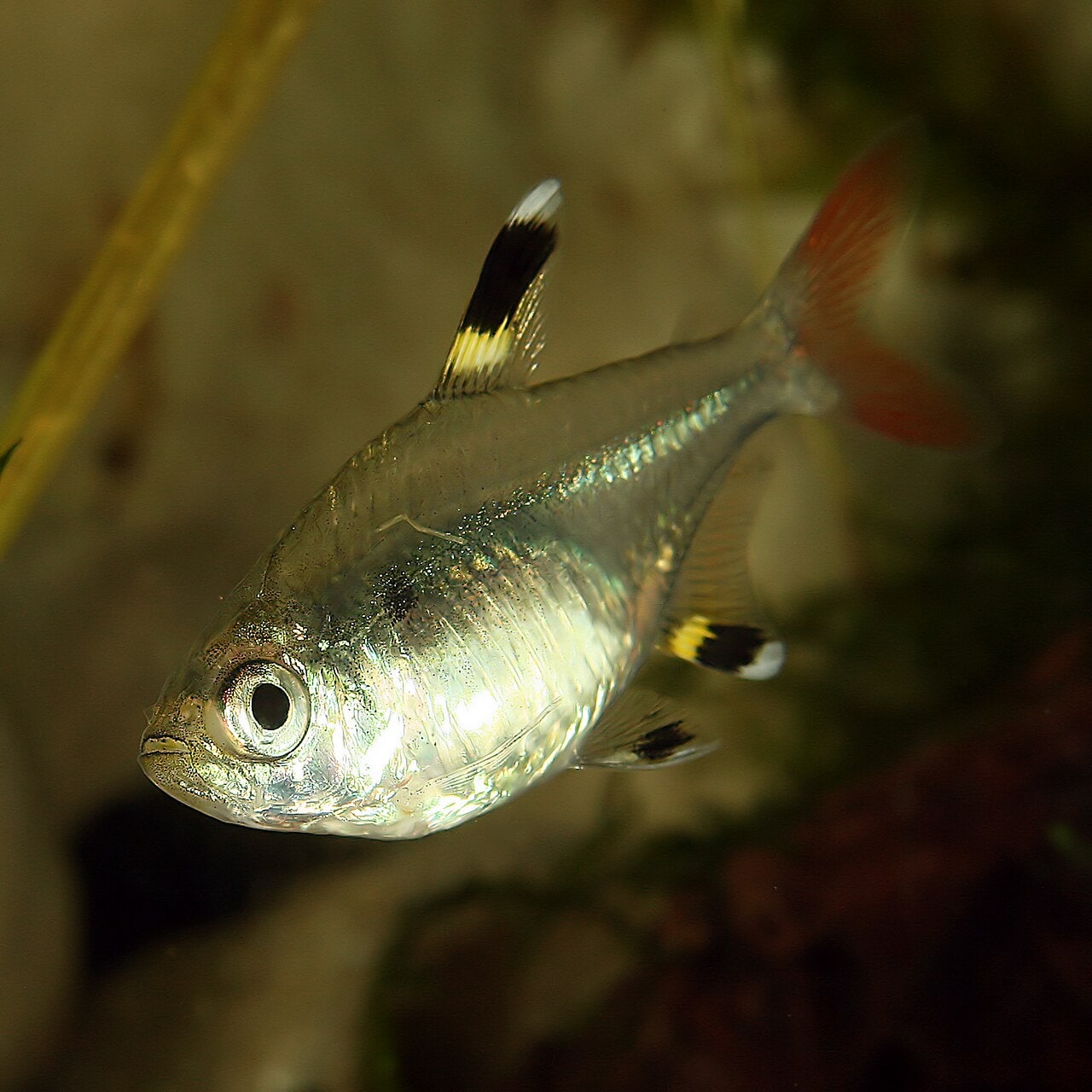
X-ray tetra
Pristella maxillaris
Also known as: x ray tetra, water goldfinch
The x-ray tetra's strength is indifference to your tap: it takes moderate hardness and a wide pH that leave fussier tetras sulking. A school of eight in a 60L is one of the most dependable small-fish purchases in the shop.
X-ray tetra tank mates · 60L tank size hub
peaceful · beginner care
Sources & confidencehigh · partially verified · beginner: excellent
Checked against several solid care sources that mostly agree. Numbers here are a careful starting point. Your tap water, tank size, and habits decide the rest. How we evaluate.
Best for: First community tanks and harder tap water: 60L or more, a school of eight, with ember tetras, pygmy corys or a sparkling gourami at the same gentle scale.
Avoid if: The tank holds anything with room in its mouth for a 4.5 cm fish — big cichlids rule themselves out — or you would stock fewer than six.
Common mistakeBuying four x-ray tetras because the bag looked full is how keepers miss the species. They school so tightly in larger groups that the transparent bodies read as one moving pattern; four fish just look sparse and nervous. Plan for six or more in roughly 60 litres with broken sight lines. Under-stocking is the mistake that makes a tough tetra look like a failed neon replacement.
Top things that go wrong
- Group welfare — not a solo display fish. Plan at least **6** together for normal behaviour; smaller groups often mean stress, colour loss, or nipping depending on species.
- Shrimp & snails. Cherry shrimp and other dwarfs can coexist with peaceful small fish; baby shrimp are food for almost anything that finds them.
What most shops don't tell you
- 1.Shops pitch x-rays as delicate glass fish for soft-water specialists only. They are a practical neon-sized school with a wider hardness tolerance when drip-acclimated, not a museum piece. The see-through body reads fragile and is not. Buy them for a real school in ordinary community water you can stabilise, not as a soft-water trophy beside fin-nippers in a bare tank.
- 2.Stocked from soft-water-only literature without drip acclimation when the tap is moderate hardness.
- 3.Housed with fin-nippers in bare tanks with nowhere to break line of sight.
- 4.Six or more for the school. Pair with calm mid and bottom fish. They want a stable mature filter and regular water changes; the colour fades in spikes.
About this species
X-ray tetras are translucent characins with a yellow-and-black banded tail. Hardier than most rainforest tetras: they tolerate harder water and a wider pH range, though planted setups still bring out the best colour.
- Beckford Pencilfish60L min · same group, comparable tank size
- Black Neon Tetra60L min · same group, comparable tank size
- Bloodfin tetra60L min · same group, comparable tank size
- Cardinal Tetra60L min · same group, comparable tank size
- Glowlight Tetra60L min · same group, comparable tank size
- Green neon tetra60L min · same group, comparable tank size
- Lemon Tetra60L min · same group, comparable tank size
- Silver Tip Tetra60L min · same group, comparable tank size
- Amano Shrimpalso beginner peaceful, similar tank size
- Assassin Snailalso beginner peaceful, similar tank size
- Beckford Pencilfishalso beginner peaceful, similar tank size
- Black Neon Tetraalso beginner peaceful, similar tank size
- Black phantom tetraalso beginner peaceful, similar tank size
- Bloodfin tetraalso beginner peaceful, similar tank size
No reverse lookups listed yet.
Plan grid
Key limits are above. Here: pH band, swim level, bioload, and activity.
Swim zones
Care snapshot
Quick compare before you buy. Not a score of how “good” the fish is.
- Beginner ease82
- Peacefulness90
- Community fit91
- Small-tank fit68
- Hardiness76
- Energy54
Numbers are deterministic planning indices from Fishori fields — not a scientific score of your individual fish.
Example setups
Starting points only. Run the pair checker for every fish you add.
Rough 90L+ layout: one calm centrepiece, 8–12 small tetras/rasboras, 6–8 corydoras-type bottom fish — verify every name in the pair checker before buying.
Safer directions include: Chili Rasbora, Dwarf Gourami, Ember Tetra.
Prioritise 6+ of X-ray tetra in 60L+ with filtration sized for messy feeding — add only mates that already pass pair checks with this species.
Compatibility
Tank mates for X-ray tetra
Usually safer (engine GOOD): Chili Rasbora, Dwarf Gourami, Ember Tetra, Harlequin Rasbora, Neon Tetra. Conditional (CAUTION — read the pair page before buying): Angelfish, Betta, Corydoras Catfish, German Blue Ram, Pea Puffer. Avoid (RISKY): African Cichlid, Green Terror, Jack Dempsey, Oscar. Every name links to a live pair check — the lists are a shortlist, not a stocking plan.
Usually safer
Open a pair page with this fish as the starting point.
Needs planning
Read the blocking rule on each pair page before experimenting.
Usually avoid
Do-not-stock combinations on conservative hobby rules.
Compare with
Run a real pair check: X-ray tetra + Chili Rasbora
Behaviour and temperament
X-ray tetras are peaceful midwater schoolers that look fragile in the bag and prove tougher than neons once settled. A fish that targets one neighbour is usually mapping feed competition, not random meanness — watch who hits the flake first. Tight schooling in a group of six or more creates the moving glass pattern people want; four fish rarely do. Clamped fins after a hard water change are a chemistry signal before a temperament one.
What sets them off
- Sudden crowding
- Poor water quality
Fin nipping: Not a habitual fin-nipper; stressed or crowded individuals can still test fins.
Predation: Not a predator toward similarly sized community fish; fry and dwarf shrimp are still fair game for most species.
Territory: Not strongly territorial, but still needs room so its working space does not overlap the next fish.
Planted tanks: excellent — easy plant ideas
In the glass: typical and warning signs
- Tight midwater school when six or more; transparent bodies read as a moving pattern.
- Peaceful dither fish that hold better than neons once settled.
- Clamped fins after undripped hardness swings.
- Sparse foursomes that hide instead of schooling.
- Not a habitual fin-nipper; feed-competition chasing is the usual spark.
- One fish constantly driven from food → check school size and feeding passes.
Fish behaviour can vary between individuals and tank setups. Always observe new fish closely after introduction.
Water, food, and grouping
Hardness
soft
Diet
omnivore
They take flake and micro-pellets in the midwater scramble and hold condition better than neons on ordinary community foods. Still offer a frozen or freeze-dried protein a few times a week so the transparent body does not look pinched behind the black-and-yellow tail. Make sure the back of the school reaches food after the first rush. If only surface speedsters eat, the x-rays thin out quietly.
Shrimp & snails
Cherry shrimp and other dwarfs can coexist with peaceful small fish; baby shrimp are food for almost anything that finds them.
Schooling species — buy 6+ together. Smaller groups stress and lose colour.
- Hold 22 to 28 °C steadily on a real thermometer, not the dial on the heater.
- Aim for pH 5.5 to 7.5 and a hardness you can re-test in two weeks. A one-time strip in the shop car park is not a water test.
- Schooling species. Buy 6 or more from the same tank on the same day before adding any centrepiece fish.
- Tank volume meets or exceeds 60L published minimum for adults.
- You can stock at least 6 individuals (group welfare).
- Heater can hold 22–28°C without cooking cooler-water tank mates.
- No known fin-nippers paired with long-finned fish unless you accept documented risk.
Explore and stocking hubs
Tank-mates hub, matching guides, category peers, and litre stocking lists around this species’ minimum tank.
Plan with tools
Check mates as pairs first, then add this fish in the tank builder for the full stocking.
Filtration & heating
A 60L minimum tank needs a filter rated for at least 240L/hr turnover and a heater to hold 22–28°C reliably.
Plant suggestions
X-ray tetra does well in planted tanks. Plants compatible with 22–28°C and pH 5.5–7.5:
Research: partially verified · Confidence: high · 3 linked source(s). We do not invent citations.
How Fishori evaluates compatibility (same logic as pair and tank tools).
- Seriously Fish. Pristella maxillaris
Supports: aquarium size, water chemistry, temperament and compatibility (primary care reference).
- FishBase. Pristella maxillaris
Supports: taxonomy and wild maximum size — translate to tank stocking, not a target number.
- Wikipedia. Pristella maxillaris
Supports: general species background and common-name orientation only.
Evidence notes
- Care numbers are cross-checked across the linked sources and biased toward the conservative end; compatibility reflects typical hobby experience, not a lab prediction. Method and full source policy: /methodology.
Common questions about X-ray tetra
- How big do X-ray tetra get?
- X-ray tetra adults reach about 4.5 cm. Shop fish look smaller; stock for the adult length.
- What size tank does X-ray tetra need?
- 60L is the planning floor for adult swimming space and bioload. A 73L+ tank is the more comfortable long-term footprint. Length and depth matter as much as raw litres for active or territorial fish.
- Are X-ray tetra aggressive?
- X-ray tetras are peaceful midwater schoolers that look fragile in the bag and prove tougher than neons once settled. A fish that targets one neighbour is usually mapping feed competition, not random meanness — watch who hits the flake first. Tight schooling in a group of six or more creates the moving glass pattern people want; four fish rarely do. Clamped fins after a hard water change are a chemistry signal before a temperament one.
- Do X-ray tetra need to be kept in a group?
- Schooling species — buy 6+ together. Smaller groups stress and lose colour.
- What is the most common mistake with X-ray tetra?
- Buying four x-ray tetras because the bag looked full is how keepers miss the species. They school so tightly in larger groups that the transparent bodies read as one moving pattern; four fish just look sparse and nervous. Plan for six or more in roughly 60 litres with broken sight lines. Under-stocking is the mistake that makes a tough tetra look like a failed neon replacement.
- What fish can live with X-ray tetra?
- The X-ray tetra profile lists Chili Rasbora, Dwarf Gourami, Ember Tetra, Harlequin Rasbora among its safer pairings (engine-checked GOOD). Angelfish, Betta, Corydoras Catfish, German Blue Ram are conditional (CAUTION): workable only with the specific conditions on each pair page. Avoid African Cichlid, Green Terror, Jack Dempsey, Oscar (RISKY). Run the pair checker for your exact water and tank size before stocking.