Should I buy it?
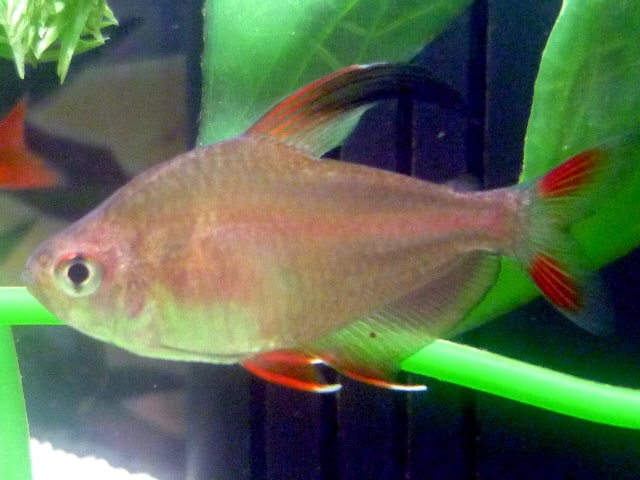
Rosy Tetra
Hyphessobrycon rosaceus
Also known as: rosaceus tetra, white tip tetra
A pink mid-size schooler for soft-water planted tanks. Less nippy than silver tips, still not safe with bettas. Six or more for colour.
Rosy Tetra tank mates · 80L tank size hub
peaceful · beginner care
Sources & confidencemedium · partially verified · beginner: good
Typical care sources — real tanks still vary. Numbers here are a careful starting point. Your tap water, tank size, and habits decide the rest. How we evaluate.
Best for: Soft-water planted community tanks 80L or more with a school of six or more for full pink colouring.
Avoid if: Your water is hard alkaline, you keep bettas or guppies, or you can only find three fish.
Common mistakeBuying only three rosy tetras is how keepers invent a weak, pale handful that schools poorly and gets harassed. Six is the real start. Add the full group at once in planted cover — three fish never look like the species people bought from the photo.
Top things that go wrong
- Fin-nipping risk in typical community layouts. Will nip long fins or slow fish when the school is too small, bored, or kept in a short tank.
- Group welfare — not a solo display fish. Plan at least **6** together for normal behaviour; smaller groups often mean stress, colour loss, or nipping depending on species.
- Shrimp & snails. Cherry shrimp and other dwarfs can coexist with peaceful small fish; baby shrimp are food for almost anything that finds them.
What most shops don't tell you
- 1.Myth: rosy tetras look fine as a decorative trio in any community tank. Reality: three fish school poorly, show less colour, and take more harassment — keep six or more in planted midwater so the species actually reads as a school.
- 2.Mixed with bettas in a 60L community. Even a proper school of rosies eventually nips the betta's fins down.
- 3.Bought as bleeding-heart tetras. The species are sometimes interchanged at the wholesaler and the larger bleeding-hearts need more volume.
- 4.More forgiving than silver tips but still a fin nipper around long-finned tank mates. A school of six or more in a planted 80L stays peaceful with cardinal tetras, corys, and otocinclus. Bettas and gouramis are not safe additions.
About this species
Rosy tetras are mid-size shoaling characins with a pink-bronze body and a white-tipped sickle-shaped dorsal fin in mature males. South American origin, soft acidic water, similar habits to silver tips but slightly less nippy in proper schools.
- Black phantom tetra80L min · same group, comparable tank size
- Columbian Tetra80L min · same group, comparable tank size
- Penguin tetra80L min · same group, comparable tank size
- Rummy Nose Tetra80L min · same group, comparable tank size
- Splash tetra80L min · same group, comparable tank size
- Beckford Pencilfish60L min · same group, similar adult size
- Black Neon Tetra60L min · same group, similar adult size
- Bloodfin tetra60L min · same group, similar adult size
- Amano Shrimpalso beginner peaceful, similar tank size
- Beckford Pencilfishalso beginner peaceful, similar tank size
- Black Neon Tetraalso beginner peaceful, similar tank size
- Black phantom tetraalso beginner peaceful, similar tank size
- Bloodfin tetraalso beginner peaceful, similar tank size
- Bristlenose Plecoalso beginner peaceful, similar tank size
No reverse lookups listed yet.
Plan grid
Key limits are above. Here: pH band, swim level, bioload, and activity.
Swim zones
Care snapshot
Quick compare before you buy. Not a score of how “good” the fish is.
- Beginner ease78
- Peacefulness68
- Community fit46
- Small-tank fit60
- Hardiness76
- Energy54
Numbers are deterministic planning indices from Fishori fields — not a scientific score of your individual fish.
Example setups
Starting points only. Run the pair checker for every fish you add.
Rough 90L+ layout: one calm centrepiece, 8–12 small tetras/rasboras, 6–8 corydoras-type bottom fish — verify every name in the pair checker before buying.
Safer directions include: Cardinal Tetra, Harlequin Rasbora.
Prioritise 6+ of Rosy Tetra in 80L+ with filtration sized for messy feeding — add only mates that already pass pair checks with this species.
Compatibility
Tank mates for Rosy Tetra
Usually safer (engine GOOD): Cardinal Tetra, Harlequin Rasbora. Conditional (CAUTION — read the pair page before buying): Angelfish, Betta, Corydoras Catfish, Dwarf Gourami, Guppy. Every name links to a live pair check — the lists are a shortlist, not a stocking plan.
Usually safer
Open a pair page with this fish as the starting point.
Needs planning
Read the blocking rule on each pair page before experimenting.
Usually avoid
Do-not-stock combinations on conservative hobby rules.
None listed. Use the pair checker before mixing.
Compare with
Run a real pair check: Rosy Tetra + Cardinal Tetra
Behaviour and temperament
Rosy tetras are peaceful schoolers that stay calmer and more colourful in groups of six or more with planted midwater cover. They do not bully robust neighbours. Stress shows as fading and skittish pacing when under-grouped in open bright water with nowhere to reform.
What sets them off
- long-finned tank mates
Fin nipping: Will nip long fins or slow fish when the school is too small, bored, or kept in a short tank.
Predation: Not a predator toward similarly sized community fish; fry and dwarf shrimp are still fair game for most species.
Territory: Not strongly territorial, but still needs room so its working space does not overlap the next fish.
Planted tanks: excellent — easy plant ideas
In the glass: typical and warning signs
- Six or more hold midwater as a soft pink school among plants.
- Colour deepens when the group feels secure after lights soften.
- A pale nervous trio usually needs more of their own kind first.
- Skittish pacing in bare bright tanks means cover failed before diet.
- Low listed risk as aggressors.
- Fin-nippers and large cichlids are the usual failure modes — not rosy malice.
- Grow the school before adding another 'active' species to fix shyness.
- Remove nippy barbs at the first torn fin.
Fish behaviour can vary between individuals and tank setups. Always observe new fish closely after introduction.
Water, food, and grouping
Hardness
soft
Diet
omnivore
Rosy tetras are midwater omnivores that take quality flake or micro-pellets plus frozen foods in a school of six or more. Token trios stay pale and nervous even when food is correct. Feed what the school finishes in planted open water, keep eighty-litre-class length, and expect colour when the group feels secure.
Shrimp & snails
Cherry shrimp and other dwarfs can coexist with peaceful small fish; baby shrimp are food for almost anything that finds them.
Six or more. A school below this fragments and males chase each other into corners.
- Six or more from the same source.
- Soft acidic water (pH 6.0 to 7.5, soft) for colour development.
- Tank mates without trailing fins.
- An 80L planted setup with a clear mid-water swim path.
- Tank volume meets or exceeds 80L published minimum for adults.
- You can stock at least 6 individuals (group welfare).
- Heater can hold 23–28°C without cooking cooler-water tank mates.
- No known fin-nippers paired with long-finned fish unless you accept documented risk.
Explore and stocking hubs
Tank-mates hub, matching guides, category peers, and litre stocking lists around this species’ minimum tank.
Plan with tools
Check mates as pairs first, then add this fish in the tank builder for the full stocking.
Filtration & heating
A 80L minimum tank needs a filter rated for at least 320L/hr turnover and a heater to hold 23–28°C reliably.
Plant suggestions
Rosy Tetra does well in planted tanks. Plants compatible with 23–28°C and pH 6–7.5:
Research: partially verified · Confidence: medium · 2 linked source(s). We do not invent citations.
How Fishori evaluates compatibility (same logic as pair and tank tools).
- Seriously Fish. Hyphessobrycon rosaceus
Primary: species page covering Amazon range, soft-water requirement, and the sickle-fin dimorphism in adult males.
- Practical Fishkeeping. Rosy Tetra Profile
Secondary: editor coverage of stocking, planted-tank scaping, and the long-fin tank-mate caveat.
Evidence notes
- Often confused with the similar-looking white-tip tetra (H. ornatus) and bleeding-heart tetra (H. erythrostigma). Care is similar but adult sizes and water needs vary slightly.
- The pink tone develops over six to twelve months in soft water with botanicals. New-tank specimens look washed out and recover slowly.
Featured compatibility checks
Curated pair pages for Rosy Tetra. Each opens a full verdict — not just a list label.
Common questions about Rosy Tetra
- How big do Rosy Tetra get?
- Rosy Tetra adults reach about 4 cm. Shop fish look smaller; stock for the adult length.
- What size tank does Rosy Tetra need?
- 80L is the planning floor for adult swimming space and bioload. A 100L+ tank is the more comfortable long-term footprint. Length and depth matter as much as raw litres for active or territorial fish.
- Are Rosy Tetra aggressive?
- Rosy tetras are peaceful schoolers that stay calmer and more colourful in groups of six or more with planted midwater cover. They do not bully robust neighbours. Stress shows as fading and skittish pacing when under-grouped in open bright water with nowhere to reform.
- Do Rosy Tetra need to be kept in a group?
- Six or more. A school below this fragments and males chase each other into corners.
- What is the most common mistake with Rosy Tetra?
- Buying only three rosy tetras is how keepers invent a weak, pale handful that schools poorly and gets harassed. Six is the real start. Add the full group at once in planted cover — three fish never look like the species people bought from the photo.
- What fish can live with Rosy Tetra?
- The Rosy Tetra profile lists Cardinal Tetra, Harlequin Rasbora among its safer pairings (engine-checked GOOD). Angelfish, Betta, Corydoras Catfish, Dwarf Gourami are conditional (CAUTION): workable only with the specific conditions on each pair page. Run the pair checker for your exact water and tank size before stocking.