Should I buy it?
Clown Killifish
Epiplatys annulatus
Also known as: banded panchax, rocket killifish
The nano surface fish that works in shrimp tanks. Soft acidic blackwater plus micro-food, and the colony settles in a 30L planted cube.
Clown Killifish tank mates · 30L tank size hub
peaceful · intermediate care
Sources & confidencemedium · partially verified · beginner: good
Typical care sources — real tanks still vary. Numbers here are a careful starting point. Your tap water, tank size, and habits decide the rest. How we evaluate.
Best for: Nano planted blackwater setups 20–40L for intermediate keepers comfortable with soft acidic water and live or frozen micro-foods.
Avoid if: Hard alkaline tap water, inability to source live or frozen micro-foods, or community tanks with larger fish.
Common mistakeBuying six clown killis and dumping ordinary community flake is how keepers invent “finicky” fish. The mouths are too small for the food everyone else eats, so the school fades while the midwater fish look fine. Match food size to the fish, keep a tight lid, and do not expect them to compete with zebra danios at dinner.
Top things that go wrong
- Group welfare — not a solo display fish. Plan at least **6** together for normal behaviour; smaller groups often mean stress, colour loss, or nipping depending on species.
- Shrimp & snails. Cherry shrimp and other dwarfs can coexist with peaceful small fish; baby shrimp are food for almost anything that finds them.
What most shops don't tell you
- 1.Shops pitch clown killifish as the universal nano community fish that works with anything peaceful. They are soft-water surface specialists with tiny mouths, and they lose food contests to almost every active midwater school. Peaceful does not mean interchangeable with neon tetras.
- 2.Bought as a single fish or pair. Clown killis lose colour and stop displaying in a group below six.
- 3.Fed flake food. The mouth cannot handle standard flake; the fish starves slowly in a tank that looks well stocked.
- 4.Easy on temperament, demanding on water and feeding. Wants soft acidic blackwater (pH 5.5 to 7.0, soft hardness). The mouth is too small for most flake; needs micro-pellets, baby brine shrimp, and frozen daphnia. A group of six or more in a planted 30L cube works.
About this species
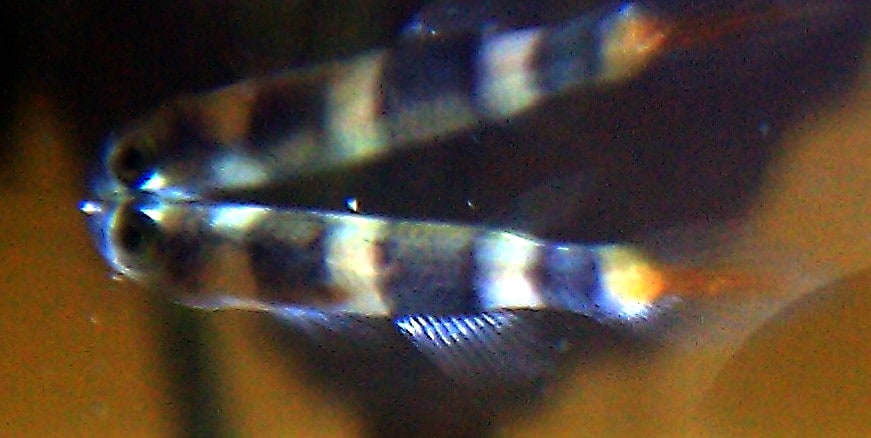
Clown killis are 3.5 cm top-dwelling killifish from West Africa. The body shows black-and-yellow bands like a wasp, and the small mouth hunts surface insects and microfauna. A peaceful nano fish that ignores tank mates below it in the water column.
- Pea Puffer40L min · same group, similar adult size
- American Flagfish60L min · same group, similar adult size
- Marbled Hatchetfish60L min · same group, similar adult size
- Golden Wonder Killifish80L min · same fish family
- African freshwater butterflyfish150L min · same fish family
- Ropefish / reed fish200L min · same fish family
- Senegal bichir300L min · same fish family
- Black ghost knifefish500L min · same fish family
- Cardinal Tetraalso intermediate peaceful, similar tank size
- Celestial Pearl Danioalso intermediate peaceful, similar tank size
- Chili Rasboraalso intermediate peaceful, similar tank size
- Dwarf pencilfishalso intermediate peaceful, similar tank size
- Golden dwarf cichlid (Nannacara)also intermediate peaceful, similar tank size
- Green neon tetraalso intermediate peaceful, similar tank size
No reverse lookups listed yet.
Plan grid
Key limits are above. Here: pH band, swim level, bioload, and activity.
Swim zones
Care snapshot
Quick compare before you buy. Not a score of how “good” the fish is.
- Beginner ease56
- Peacefulness90
- Community fit79
- Small-tank fit100
- Hardiness54
- Energy54
Numbers are deterministic planning indices from Fishori fields — not a scientific score of your individual fish.
Example setups
Starting points only. Run the pair checker for every fish you add.
Rough 90L+ layout: one calm centrepiece, 8–12 small tetras/rasboras, 6–8 corydoras-type bottom fish — verify every name in the pair checker before buying.
Safer directions include: Cherry Shrimp, Chili Rasbora, Ember Tetra.
Prioritise 6+ of Clown Killifish in 20L+ with filtration sized for messy feeding — add only mates that already pass pair checks with this species.
Compatibility
Tank mates for Clown Killifish
Usually safer (engine GOOD): Cherry Shrimp, Chili Rasbora, Ember Tetra. Conditional (CAUTION — read the pair page before buying): Common Pleco, Corydoras Catfish, Otocinclus. Avoid (RISKY): Jack Dempsey, Oscar. Every name links to a live pair check — the lists are a shortlist, not a stocking plan.
Usually safer
Open a pair page with this fish as the starting point.
Needs planning
Read the blocking rule on each pair page before experimenting.
Usually avoid
Do-not-stock combinations on conservative hobby rules.
Compare with
Run a real pair check: Clown Killifish + Cherry Shrimp
- Try Cherry Shrimp — open the pair check.
- Try Chili Rasbora — open the pair check.
- Try Ember Tetra — open the pair check.
Behaviour and temperament
Clown killifish are peaceful surface schoolers that flare more at each other than at tank mates. Males display and chase lightly inside a proper group; damage to other species is uncommon when mouths and pace match. A lone fish or a trio in a busy community looks washed out and hides under floating cover.
What sets them off
- Sudden crowding
- Poor water quality
Fin nipping: Not a habitual fin-nipper; stressed or crowded individuals can still test fins.
Predation: Not a predator toward similarly sized community fish; fry and dwarf shrimp are still fair game for most species.
Territory: Not strongly territorial, but still needs room so its working space does not overlap the next fish.
Planted tanks: excellent — easy plant ideas
In the glass: typical and warning signs
- Males flash colour and chase inside a school of six or more at the surface film.
- They ignore the sand almost entirely when food stays in the top centimetre.
- Hiding under cover all day with no surface feeding usually means food size or competition, not a mystery disease.
- Jumping after a fright is normal — a loose lid turns a nano project into an empty tank.
- In-school male displays are normal sorting, not a reason to break the group up.
- They rarely start fights with midwater fish; they lose space and food instead.
- Remove them from any tank where larger surface fish claim the film and starve the school.
- A betta that flares at every surface flash is the wrong roommate — rehome one side.
Fish behaviour can vary between individuals and tank setups. Always observe new fish closely after introduction.
Water, food, and grouping
Hardness
soft
Diet
carnivore
Clown killifish are tiny surface carnivores with mouths that ignore standard flake. Micro-pellets, crushed flake, and frozen baby brine or daphnia that stay in the film get taken; wafers on the sand rot unnoticed. Feed small pinches they can finish at the surface, and rotate a live or frozen micro-food a few times a week so the school holds condition in a planted nano.
Shrimp & snails
Cherry shrimp and other dwarfs can coexist with peaceful small fish; baby shrimp are food for almost anything that finds them.
Six or more for the colour and the rocket-swim display. A pair sulks and stays grey.
- Soft acidic water (pH 5.5 to 7.0, soft). RO with tannin additives or a planted blackwater scape works.
- Tight lid. They jump less than golden wonders but still find gaps.
- Micro-feed source: micro-pellets, frozen baby brine shrimp, or live microworms.
- A group of six or more so the colour and shoaling behaviour emerge.
- Tank volume meets or exceeds 20L published minimum for adults.
- You can stock at least 6 individuals (group welfare).
- Heater can hold 22–28°C without cooking cooler-water tank mates.
Explore and stocking hubs
Tank-mates hub, matching guides, category peers, and litre stocking lists around this species’ minimum tank.
Plan with tools
Check mates as pairs first, then add this fish in the tank builder for the full stocking.
Filtration & heating
A 20L minimum tank needs a filter rated for at least 80L/hr turnover and a heater to hold 22–28°C reliably.
Plant suggestions
Clown Killifish does well in planted tanks. Plants compatible with 22–28°C and pH 5.5–7:
Research: partially verified · Confidence: medium · 2 linked source(s). We do not invent citations.
How Fishori evaluates compatibility (same logic as pair and tank tools).
- Seriously Fish. Epiplatys annulatus
Primary: species page covering West African blackwater origin, soft water needs, and the rocket-like swim pattern.
- Practical Fishkeeping. Clown Killifish Profile
Secondary: editor write-up on tank-bred lines, feeding strategy (micro-pellets, BBS), and shrimp-tank compatibility.
Evidence notes
- Clown killis are one of the few surface-dwelling killifish that stay small enough to be genuinely shrimp-safe. Adult cherry shrimp share tanks with breeding colonies without issue, and only the smallest shrimplets are at any risk.
- Wild blackwater origin means tank-bred specimens still do better with peat or alder-cone tannins added to the water. Plain tap water keeps them alive but kills the colour.
Featured compatibility checks
Curated pair pages for Clown Killifish. Each opens a full verdict — not just a list label.
Common questions about Clown Killifish
- How big do Clown Killifish get?
- Clown Killifish adults reach about 3.5 cm. Shop fish look smaller; stock for the adult length.
- What size tank does Clown Killifish need?
- 20L is the planning floor for adult swimming space and bioload. A 30L+ tank is the more comfortable long-term footprint. Length and depth matter as much as raw litres for active or territorial fish.
- Are Clown Killifish aggressive?
- Clown killifish are peaceful surface schoolers that flare more at each other than at tank mates. Males display and chase lightly inside a proper group; damage to other species is uncommon when mouths and pace match. A lone fish or a trio in a busy community looks washed out and hides under floating cover.
- Do Clown Killifish need to be kept in a group?
- Six or more for the colour and the rocket-swim display. A pair sulks and stays grey.
- What is the most common mistake with Clown Killifish?
- Buying six clown killis and dumping ordinary community flake is how keepers invent “finicky” fish. The mouths are too small for the food everyone else eats, so the school fades while the midwater fish look fine. Match food size to the fish, keep a tight lid, and do not expect them to compete with zebra danios at dinner.
- What fish can live with Clown Killifish?
- The Clown Killifish profile lists Cherry Shrimp, Chili Rasbora, Ember Tetra among its safer pairings (engine-checked GOOD). Common Pleco, Corydoras Catfish, Otocinclus are conditional (CAUTION): workable only with the specific conditions on each pair page. Avoid Jack Dempsey, Oscar (RISKY). Run the pair checker for your exact water and tank size before stocking.