Should I buy it?
Golden Wonder Killifish
Aplocheilus lineatus
Also known as: golden wonder killi, striped panchax, Indian killifish
A surface micropredator with a misleading killifish label. Species-only or mid-size community, never with nano tetras or shrimp. Cover the tank.
Golden Wonder Killifish tank mates · 80L tank size hub
semi-aggressive · intermediate care
Sources & confidencemedium · partially verified · beginner: caution
Typical care sources — real tanks still vary. Numbers here are a careful starting point. Your tap water, tank size, and habits decide the rest. How we evaluate.
Best for: Species-only or large-fish community tanks 80L or more with a secure lid. An intermediate-keeper surface predator.
Avoid if: You keep nano fish, shrimp, or any surface-dwelling species small enough to fit in a 10 cm mouth.
Common mistakeForgetting a tight lid is the golden-wonder ownership mistake that empties the tank overnight. They jump powerfully and clear loose covers. Pair that with tiny nano fish and you also invent predation — these killis are hunters at the surface, not peaceful dither for a shrimp nano.
Top things that go wrong
- Mouth gap vs tiny tank mates. May eat tank mates small enough to fit the adult mouth — plan adult sizes, not shop sizes.
- Shrimp & snails. Not shrimp-safe — adults, fry, or both get eaten.
What most shops don't tell you
- 1.Myth: golden wonder killifish are peaceful community surface fish for any planted tank. Reality: they jump, hunt small fish, and need a sealed lid plus honest neighbour size — a pretty killi is not a nano dither sticker you can leave uncovered overnight.
- 2.Confirmed jumper. An uncovered tank loses the fish within days.
- 3.Bought as a calm-looking nano predator for a planted community. Neon tetras and guppies disappear over the first month.
- 4.Open-top scaped tank. The killifish jumps within the first week, sometimes the first night.
- 5.Not a community fish despite the killifish tag. A golden wonder in a 60L with neons will eat the neons over a few weeks. The workable plan is a 80L species tank or a community of larger mid-water fish that stay below 7 cm.
About this species
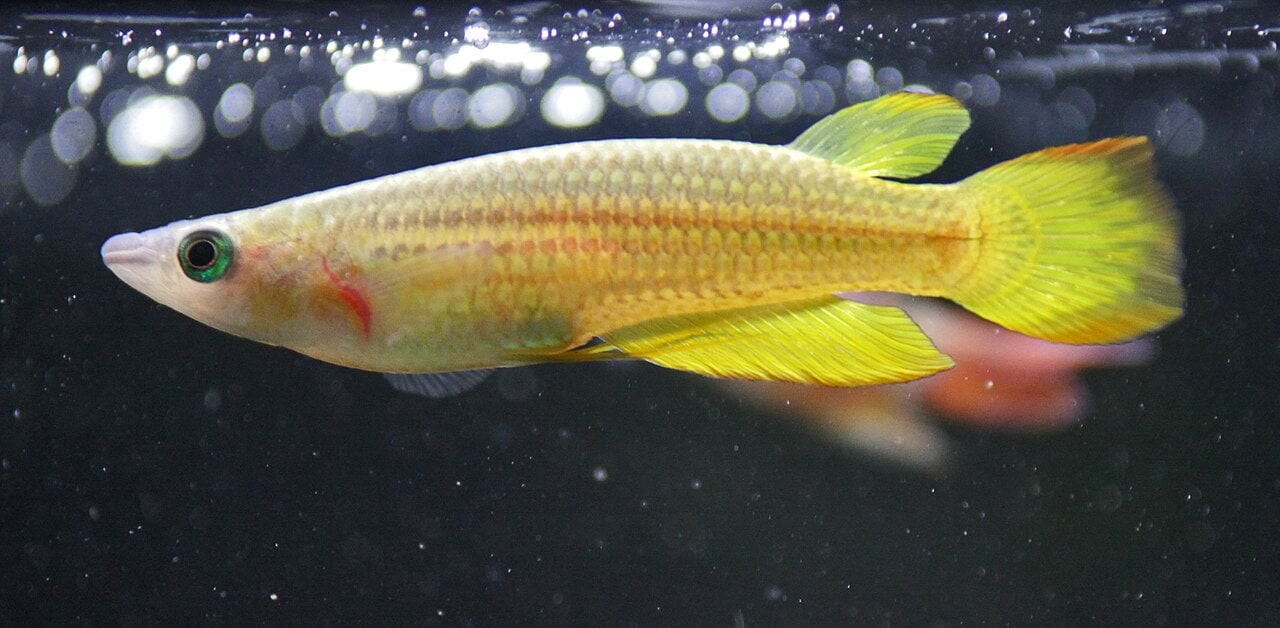
Golden wonder killis are surface-dwelling micropredators from India and Sri Lanka. Adults reach 10 cm with a pike-like body shape and metallic gold flanks. They sit just below the waterline and lunge at anything that fits in the mouth, including small tetras and shrimp.
- American Flagfish60L min · same fish family
- Marbled Hatchetfish60L min · same fish family
- Pea Puffer40L min · same fish family
- Clown Killifish20L min · same fish family
- African freshwater butterflyfish150L min · same group, similar adult size
- Ropefish / reed fish200L min · same fish family
- Senegal bichir300L min · same fish family
- Black ghost knifefish500L min · same fish family
- Agassiz’s dwarf cichlidalso intermediate semi-aggressive, similar tank size
- American Flagfishalso intermediate semi-aggressive, similar tank size
- Apistogramma Borelliialso intermediate semi-aggressive, similar tank size
- Apistogramma Macmasterialso intermediate semi-aggressive, similar tank size
- Apistogramma Trifasciataalso intermediate semi-aggressive, similar tank size
- Cockatoo / crested Apistogrammaalso intermediate semi-aggressive, similar tank size
No reverse lookups listed yet.
Plan grid
Key limits are above. Here: pH band, swim level, bioload, and activity.
Swim zones
Care snapshot
Quick compare before you buy. Not a score of how “good” the fish is.
- Beginner ease38
- Peacefulness20
- Community fit0
- Small-tank fit60
- Hardiness54
- Energy54
Numbers are deterministic planning indices from Fishori fields — not a scientific score of your individual fish.
Example setups
Starting points only. Run the pair checker for every fish you add.
Match temperature and pH overlap with every tank mate, then verify adult size and group rules on pair pages — Fishori is biased toward boring, survivable plans.
Compatibility
Tank mates for Golden Wonder Killifish
No unconditional “safe” tank mates are listed for Golden Wonder Killifish — this shortlist has CAUTION pairings that need specific conditions and RISKY pairings to avoid. Conditional (CAUTION — read the pair page before buying): Bristlenose Pleco, Dwarf Gourami. Avoid (RISKY): Cherry Shrimp, Ember Tetra, Guppy, Neon Tetra. Every name links to a live pair check — the lists are a shortlist, not a stocking plan.
Usually safer
Open a pair page with this fish as the starting point.
None listed. Use the pair checker before mixing.
Needs planning
Read the blocking rule on each pair page before experimenting.
Usually avoid
Do-not-stock combinations on conservative hobby rules.
No safe-mate list on this record yet. Use the fish index to find species with similar care, then run a pair check before you buy.
Behaviour and temperament
Golden wonder killifish are semi-aggressive surface hunters that ignore robust midwater fish they cannot eat and lean on tiny dither after dark. They are not school fish in the tetra sense. Stress shows as frantic jumping when the lid is loose or the tank is bare and bright.
What sets them off
- small tank mates
- feeding times
Fin nipping: Not a habitual fin-nipper; stressed or crowded individuals can still test fins.
Predation: May eat tank mates small enough to fit the adult mouth — plan adult sizes, not shop sizes.
Territory: Not strongly territorial, but still needs room so its working space does not overlap the next fish.
Planted tanks: good — easy plant ideas
In the glass: typical and warning signs
- A fish or pair patrols the surface film and strikes at floating or midwater prey.
- Jumping after a fright is normal — the lid is part of the husbandry, not optional décor.
- Repeated lid escapes mean cover failed, not a mystery urge to explore the room.
- Missing nano fish after lights-out means predation, not a filter intake mystery.
- Not midwater bullies by day; mouth size and surface hunting are the real risks.
- Males may spar; serious damage is less common than lost tank mates that fit the gape.
- Remove nano tetras and shrimp the first week counts drop overnight.
- Rehome the killi if the tank cannot give a sealed lid and robust neighbours.
Fish behaviour can vary between individuals and tank setups. Always observe new fish closely after introduction.
Water, food, and grouping
Hardness
medium
Diet
carnivore
Golden wonder killifish are surface carnivores that take frozen foods and floating pellets once settled. Food that sinks past them too fast leaves them hunting the glass. Offer bloodworm, brine, or similar protein at the film a few times a week, and keep portions the fish can finish without fouling a planted top.
Shrimp & snails
Not shrimp-safe — adults, fry, or both get eaten.
Solo or as a single pair in 80L+. A second male without enough length usually ends with one fish hiding under the filter intake permanently.
- A flush-fitting lid with no gaps. Even glass feeding holes need a coverslip.
- Tank mates that are too big to fit in the killifish's mouth. Mid-7 cm rasboras and 5 cm corydoras work; nano tetras and shrimp do not.
- Live or frozen food source. Pellets work but live feeds (bloodworms, brine) bring out colour.
- Tank volume meets or exceeds 80L published minimum for adults.
- Heater can hold 22–28°C without cooking cooler-water tank mates.
- No tank mates small enough to fit the adult mouth gap for this species.
Explore and stocking hubs
Tank-mates hub, matching guides, category peers, and litre stocking lists around this species’ minimum tank.
Plan with tools
Check mates as pairs first, then add this fish in the tank builder for the full stocking.
Filtration & heating
A 80L minimum tank needs a filter rated for at least 320L/hr turnover and a heater to hold 22–28°C reliably.
Plant suggestions
Golden Wonder Killifish does well in planted tanks. Plants compatible with 22–28°C and pH 6–8:
Research: partially verified · Confidence: medium · 2 linked source(s). We do not invent citations.
How Fishori evaluates compatibility (same logic as pair and tank tools).
- Seriously Fish. Aplocheilus lineatus
Primary: species page covering Indian/Sri Lankan range, predatory behaviour, jumping risk, and surface-dwelling habit.
- Aquarium Co-Op. Golden Wonder Killifish Care
Secondary: retailer care page on stocking (top-dweller-only setups, jumping lid requirement, live feed).
Evidence notes
- Wild Aplocheilus lineatus is olive and grey. The 'golden wonder' is a selectively bred colour line that exaggerates the yellow-gold flanks. Care is identical between forms.
- Golden wonders are confirmed jumpers. A tight-fitting lid with no escape gaps is non-negotiable, even on tanks where most fish stay deep.
Featured compatibility checks
Curated pair pages for Golden Wonder Killifish. Each opens a full verdict — not just a list label.
Common questions about Golden Wonder Killifish
- How big do Golden Wonder Killifish get?
- Golden Wonder Killifish adults reach about 10 cm. Shop fish look smaller; stock for the adult length.
- What size tank does Golden Wonder Killifish need?
- 80L is the planning floor for adult swimming space and bioload. A 100L+ tank is the more comfortable long-term footprint. Length and depth matter as much as raw litres for active or territorial fish.
- Are Golden Wonder Killifish aggressive?
- Golden wonder killifish are semi-aggressive surface hunters that ignore robust midwater fish they cannot eat and lean on tiny dither after dark. They are not school fish in the tetra sense. Stress shows as frantic jumping when the lid is loose or the tank is bare and bright.
- What is the most common mistake with Golden Wonder Killifish?
- Forgetting a tight lid is the golden-wonder ownership mistake that empties the tank overnight. They jump powerfully and clear loose covers. Pair that with tiny nano fish and you also invent predation — these killis are hunters at the surface, not peaceful dither for a shrimp nano.
- What fish can live with Golden Wonder Killifish?
- This profile currently has no curated unconditional safe-mates shortlist for Golden Wonder Killifish. Other species may still return GOOD in the pair checker, so check the exact pair rather than treating this shortlist as exhaustive. Bristlenose Pleco, Dwarf Gourami are conditional (CAUTION): workable only with the specific conditions on each pair page. Avoid Cherry Shrimp, Ember Tetra, Guppy, Neon Tetra (RISKY). Run the pair checker for your exact water and tank size before stocking.