Should I buy it?
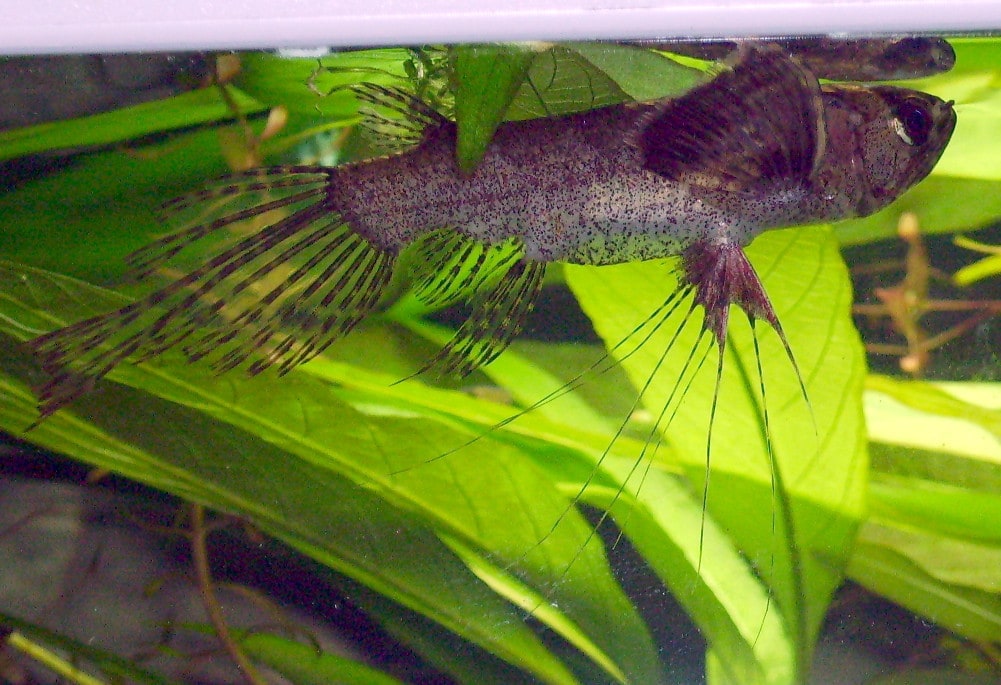
African freshwater butterflyfish
Pantodon buchholzi
Also known as: african butterfly fish, freshwater butterflyfish
A predator that lives in the top two centimetres of the tank and treats everything there as food, a rival or an exit. Below the waterline it is genuinely peaceful, so plan the surface and the rest plans itself.
African freshwater butterflyfish tank mates · 160L tank size hub
peaceful · intermediate care
Sources & confidencehigh · partially verified · beginner: caution
Checked against several solid care sources that mostly agree. Numbers here are a careful starting point. Your tap water, tank size, and habits decide the rest. How we evaluate.
Best for: Long tanks of 150 litres or more with an unbroken surface, floating cover, a sealed lid, and mid or bottom company too large to swallow.
Avoid if: Anything else lives at the surface, your smallest fish fits a surprisingly wide mouth, or your lid has gaps.
Common mistakeMixing African butterflyfish with other surface specialists in a short tank is how keepers invent a mean oddball. They claim the waterline and attack anything that shares that zone, and tiny top-water tetras disappear one by one. Give them length at the top — roughly 150 litres class with a sealed lid — and skip surface tank mates. The mistake is reading “peaceful” as “shares the film with everyone.”
Top things that go wrong
- Fin-nipping risk in typical community layouts. Will nip long fins or slow fish when the school is too small, bored, or kept in a short tank.
- Mouth gap vs tiny tank mates. May eat tank mates small enough to fit the adult mouth — plan adult sizes, not shop sizes.
- Shrimp & snails. Not shrimp-safe — adults, fry, or both get eaten.
What most shops don't tell you
- 1.Shops still place butterflies next to hatchetfish and tiny surface tetras because the bag looks calm. At home the wide mouth and surface territory show up within weeks. They are not a community top-dweller for nano schools. Buy them for a sealed, long surface with fish too large to swallow, or skip the species if the top plane is already spoken for.
- 2.Tall narrow tanks with almost no top length. The fish cannot patrol or feed naturally.
- 3.Communities led by tiny top-water tetras. The butterfly picks them off at the surface.
- 4.Lid gaps are the leading exit route. If you can slide a business card under a corner, assume the fish can leave through it. Feed at the surface and re-check that midwater tank mates are not the right size to be swallowed by your import.
About this species
- Ropefish / reed fish200L min · same fish family
- Golden Wonder Killifish80L min · same group, similar adult size
- American Flagfish60L min · same fish family
- Marbled Hatchetfish60L min · same fish family
- Clown Killifish20L min · same fish family
- Senegal bichir300L min · same fish family
- Black ghost knifefish500L min · same fish family
- Adolfoi coryalso intermediate peaceful, similar tank size
- Bamboo Shrimpalso intermediate peaceful, similar tank size
- Black ruby barbalso intermediate peaceful, similar tank size
- Boesemani Rainbowfishalso intermediate peaceful, similar tank size
- Bolivian Ramalso intermediate peaceful, similar tank size
- Brown / hockey-stick pencilfishalso intermediate peaceful, similar tank size
No reverse lookups listed yet.
Plan grid
Key limits are above. Here: pH band, swim level, bioload, and activity.
Swim zones
Care snapshot
Quick compare before you buy. Not a score of how “good” the fish is.
- Beginner ease32
- Peacefulness36
- Community fit0
- Small-tank fit42
- Hardiness54
- Energy24
Numbers are deterministic planning indices from Fishori fields — not a scientific score of your individual fish.
Example setups
Starting points only. Run the pair checker for every fish you add.
Match temperature and pH overlap with every tank mate, then verify adult size and group rules on pair pages — Fishori is biased toward boring, survivable plans.
Compatibility
Tank mates for African freshwater butterflyfish
No unconditional “safe” tank mates are listed for African freshwater butterflyfish — this shortlist has CAUTION pairings that need specific conditions and RISKY pairings to avoid. Conditional (CAUTION — read the pair page before buying): Angelfish, Bala / silver shark, Boesemani Rainbowfish, Congo Tetra, Corydoras Catfish. Avoid (RISKY): Chili Rasbora, Ember Tetra, Guppy, Neon Tetra, Pea Puffer. Every name links to a live pair check — the lists are a shortlist, not a stocking plan.
Usually safer
Open a pair page with this fish as the starting point.
None listed. Use the pair checker before mixing.
Needs planning
Read the blocking rule on each pair page before experimenting.
Usually avoid
Do-not-stock combinations on conservative hobby rules.
No safe-mate list on this record yet. Use the fish index to find species with similar care, then run a pair check before you buy.
Behaviour and temperament
The peaceful label is honest below the waterline and misleading at the surface. African butterflyfish are ambush hunters with a wide mouth; they park under spray and pick anything small enough that drifts into the top centimetre. Rival surface fish get chased out of that zone rather than tolerated. Midwater tetras that stay deep may be ignored; top-water nanos are dinner planning.
What sets them off
- Small groups or boredom
- Long-finned or slow tank mates
- Bare tanks without structure
Fin nipping: Will nip long fins or slow fish when the school is too small, bored, or kept in a short tank.
Predation: May eat tank mates small enough to fit the adult mouth — plan adult sizes, not shop sizes.
Territory: Not strongly territorial, but still needs room so its working space does not overlap the next fish.
Planted tanks: good — easy plant ideas
In the glass: typical and warning signs
- Still surface hunting under cover; sudden strikes at film insects and small fish.
- Hangs under spray bars and floating plants rather than cruising midwater.
- Pacing the lid edge or jumping attempts after lid gaps — seal the tank.
- Pinched body on flake-only sinking diets while bottom fish stay fat.
- Surface territory fights with other top-dwellers; predation on nano fish at the film.
- Missing top-water nanos overnight → assume predation first.
- Chronic jumping → lid failure, not random restlessness.
Fish behaviour can vary between individuals and tank setups. Always observe new fish closely after introduction.
Water, food, and grouping
Hardness
soft
Diet
carnivore
These are surface carnivores. Floating insects, freeze-dried flies, and meaty foods that sit in the film get taken; sinking wafers often rot unnoticed. Feed where the fish actually holds — the top plane — and expect slower, deliberate strikes rather than a community rush. A dry flake-only diet leaves them thin while bottom fish look fine. If the surface stays untouched at feed time, the food is the wrong type or the wrong place.
Shrimp & snails
Not shrimp-safe — adults, fry, or both get eaten.
African freshwater butterflyfish is fine singly or as a researched pair — check behaviour before doubling up.
- Hold 23 to 30 °C steadily on a real thermometer, not the dial on the heater.
- Aim for pH 5.5 to 7.2 and a hardness you can re-test in two weeks. A one-time strip in the shop car park is not a water test.
- Footprint: short wide tanks and tall narrow tanks fish differently for the same volume. Match the tank shape to the swim pattern, not just the litre count.
- Tank volume meets or exceeds 150L published minimum for adults.
- Heater can hold 23–30°C without cooking cooler-water tank mates.
- No known fin-nippers paired with long-finned fish unless you accept documented risk.
- No tank mates small enough to fit the adult mouth gap for this species.
Explore and stocking hubs
Tank-mates hub, matching guides, category peers, and litre stocking lists around this species’ minimum tank.
Plan with tools
Check mates as pairs first, then add this fish in the tank builder for the full stocking.
Filtration & heating
A 150L minimum tank needs a filter rated for at least 600L/hr turnover and a heater to hold 23–30°C reliably.
Plant suggestions
African freshwater butterflyfish does well in planted tanks. Plants compatible with 23–30°C and pH 5.5–7.2:
Research: partially verified · Confidence: high · 3 linked source(s). We do not invent citations.
How Fishori evaluates compatibility (same logic as pair and tank tools).
- Seriously Fish. Pantodon buchholzi
Supports: aquarium size, water chemistry, temperament and compatibility (primary care reference).
- FishBase. Pantodon buchholzi
Supports: taxonomy and wild maximum size — translate to tank stocking, not a target number.
- Wikipedia. Pantodon buchholzi
Supports: general species background and common-name orientation only.
Evidence notes
- Care numbers are cross-checked across the linked sources and biased toward the conservative end; compatibility reflects typical hobby experience, not a lab prediction. Method and full source policy: /methodology.
Common questions about African freshwater butterflyfish
- How big do African freshwater butterflyfish get?
- African freshwater butterflyfish adults reach about 10 cm. Shop fish look smaller; stock for the adult length.
- What size tank does African freshwater butterflyfish need?
- By raw litres this is an 80 L fish, and Seriously Fish says as much. We hold the line at 150 L because litres are the wrong unit for a surface ambush predator: what matters is uninterrupted surface area, and the 150 L class is the first size whose footprint gives a butterfly a real glide lane plus calm water away from the filter return. Depth underneath it is nearly irrelevant.
- Are African freshwater butterflyfish aggressive?
- The peaceful label is honest below the waterline and misleading at the surface. African butterflyfish are ambush hunters with a wide mouth; they park under spray and pick anything small enough that drifts into the top centimetre. Rival surface fish get chased out of that zone rather than tolerated. Midwater tetras that stay deep may be ignored; top-water nanos are dinner planning.
- What is the most common mistake with African freshwater butterflyfish?
- Mixing African butterflyfish with other surface specialists in a short tank is how keepers invent a mean oddball. They claim the waterline and attack anything that shares that zone, and tiny top-water tetras disappear one by one. Give them length at the top — roughly 150 litres class with a sealed lid — and skip surface tank mates. The mistake is reading “peaceful” as “shares the film with everyone.”
- What fish can live with African freshwater butterflyfish?
- This profile currently has no curated unconditional safe-mates shortlist for African freshwater butterflyfish. Other species may still return GOOD in the pair checker, so check the exact pair rather than treating this shortlist as exhaustive. Angelfish, Bala / silver shark, Boesemani Rainbowfish, Congo Tetra are conditional (CAUTION): workable only with the specific conditions on each pair page. Avoid Chili Rasbora, Ember Tetra, Guppy, Neon Tetra (RISKY). Run the pair checker for your exact water and tank size before stocking.