Should I buy it?
American Flagfish
Jordanella floridae
Also known as: flagfish, florida flagfish
A killifish that earns its place eating the hair algae nothing else touches, and charges in fins when the work runs out. Right in a robust unheated set-up; wrong near anything slow or trailing.
American Flagfish tank mates · 60L tank size hub
semi-aggressive · intermediate care
Sources & confidencemedium · partially verified · beginner: caution
Typical care sources — real tanks still vary. Numbers here are a careful starting point. Your tap water, tank size, and habits decide the rest. How we evaluate.
Best for: Temperate planted tanks 60L or more wanting hair algae removal from an active fish that earns its place. Works well with corydoras.
Avoid if: You keep bettas, shrimp, or any slow long-finned fish. American flagfish nip fins as a default behaviour.
Common mistakeBuying flagfish as a peaceful algae crew for a betta tank is the fortnight fin-shred story. They target hair algae, not every algae type, and a bored male will turn on long fins when the job ends. Keep one male per roughly 60 litres with grazing work and short-finned neighbours — or skip the betta pairing. The mistake is hiring a killifish as a polite cleaner.
Top things that go wrong
- Fin-nipping risk in typical community layouts. Will nip long fins or slow fish when the school is too small, bored, or kept in a short tank.
- Shrimp & snails. Shrimp are a gamble with this fish; some ignore them, some clear a colony in days.
What most shops don't tell you
- 1.Shops sell flagfish as community algae eaters that will tidy any planted tank. They specialise in hair algae, ignore much of the rest, and can nip bettas and slow fish when under-worked. The flag pattern is not a promise of manners. Buy them for coolish planted setups with a real grazing workload, not as a betta-safe janitor.
- 2.Bought as a peaceful algae crew for a betta tank. The flagfish eats the betta's fins within a fortnight.
- 3.Solo male in a clean tank. Without hair algae to eat or a female to display at, the male turns on slower tank mates.
- 4.A real algae crew fish for the temperate community. Wants room-temperature water (18 to 26 C works), eats hair algae other species ignore, and nips fins of anything slower than itself. Skip bettas, fancy guppies, and shrimp colonies.
About this species
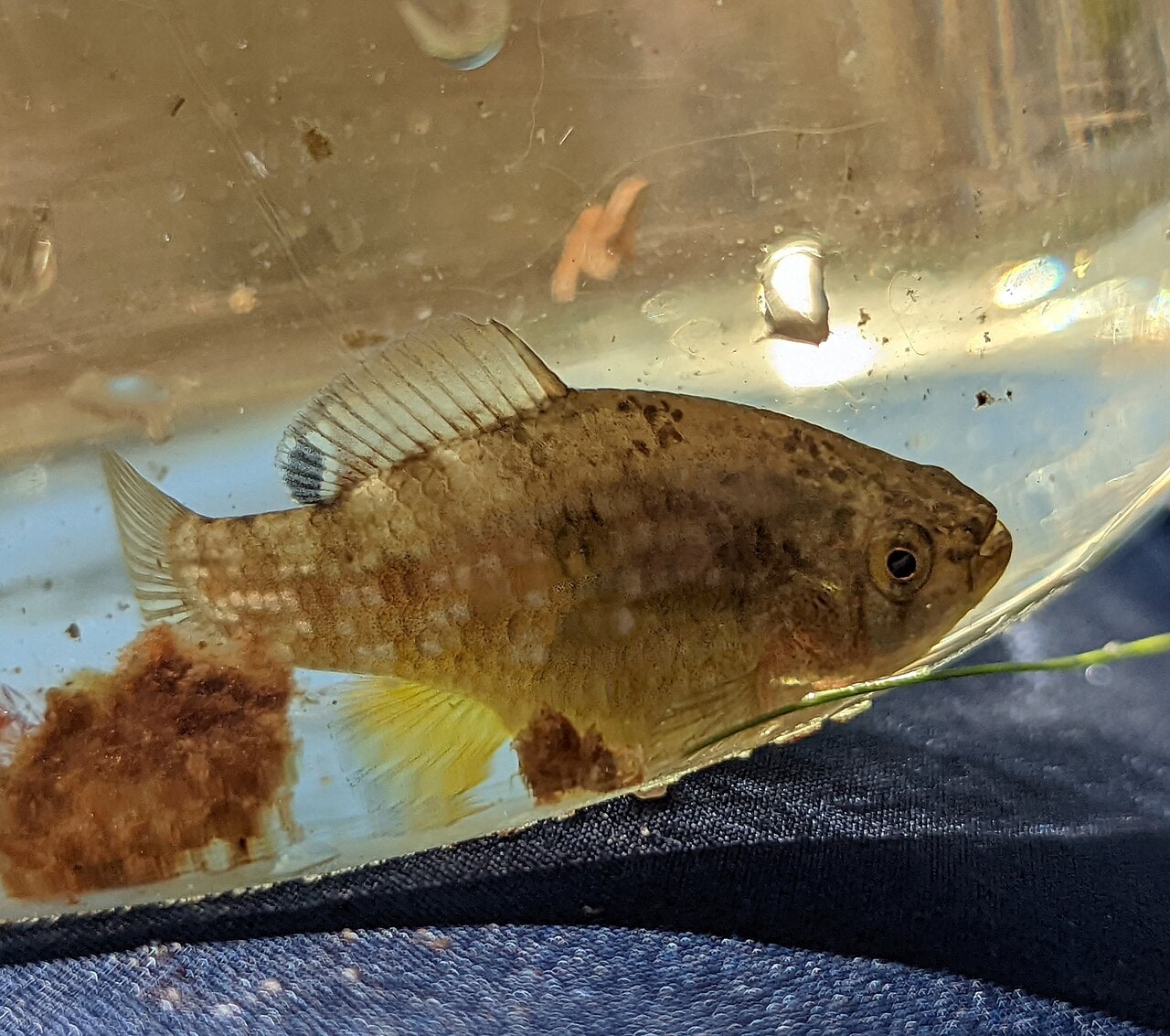
American flagfish are 6 cm North American killifish with red, blue, and yellow bands that read like a small flag. The species eats hair algae and blackbeard aggressively, which makes it a working algae crew member in a robust tank. Males are confirmed fin nippers.
- Marbled Hatchetfish60L min · same group, comparable tank size
- Golden Wonder Killifish80L min · same fish family
- Pea Puffer40L min · same group, similar adult size
- Clown Killifish20L min · same group, similar adult size
- African freshwater butterflyfish150L min · same fish family
- Ropefish / reed fish200L min · same fish family
- Senegal bichir300L min · same fish family
- Black ghost knifefish500L min · same fish family
- Agassiz’s dwarf cichlidalso intermediate semi-aggressive, similar tank size
- Apistogramma Borelliialso intermediate semi-aggressive, similar tank size
- Apistogramma Macmasterialso intermediate semi-aggressive, similar tank size
- Apistogramma Trifasciataalso intermediate semi-aggressive, similar tank size
- Cockatoo / crested Apistogrammaalso intermediate semi-aggressive, similar tank size
- Golden Wonder Killifishalso intermediate semi-aggressive, similar tank size
No reverse lookups listed yet.
Plan grid
Key limits are above. Here: pH band, swim level, bioload, and activity.
Swim zones
Care snapshot
Quick compare before you buy. Not a score of how “good” the fish is.
- Beginner ease38
- Peacefulness22
- Community fit0
- Small-tank fit68
- Hardiness54
- Energy54
Numbers are deterministic planning indices from Fishori fields — not a scientific score of your individual fish.
Example setups
Starting points only. Run the pair checker for every fish you add.
Avoid “one of everything” baskets — American Flagfish belongs in a plan built around territory, line-of-sight breaks, and matched water chemistry.
Compatibility
Tank mates for American Flagfish
No unconditional “safe” tank mates are listed for American Flagfish — this shortlist has CAUTION pairings that need specific conditions and RISKY pairings to avoid. Conditional (CAUTION — read the pair page before buying): Angelfish, Bristlenose Pleco, Cherry Shrimp, Guppy, Harlequin Rasbora. Avoid (RISKY): Betta. Every name links to a live pair check — the lists are a shortlist, not a stocking plan.
Usually safer
Open a pair page with this fish as the starting point.
None listed. Use the pair checker before mixing.
Needs planning
Read the blocking rule on each pair page before experimenting.
Usually avoid
Do-not-stock combinations on conservative hobby rules.
No safe-mate list on this record yet. Use the fish index to find species with similar care, then run a pair check before you buy.
Behaviour and temperament
American flagfish are semi-aggressive killifish that stay quiet while hair algae and grazing keep them busy, then nip when the tank runs out of work. Males display and defend spawning sites; a single bored male in a spotless tank targets slower fins. Semi-aggressive here is hunger and territory, not random oscar-level warfare. Algae and vegetable foods change the behaviour people misread as a bad fish.
What sets them off
- long-finned tank mates
- lack of algae
- spawning sites
Fin nipping: Will nip long fins or slow fish when the school is too small, bored, or kept in a short tank.
Predation: Not a predator toward similarly sized community fish; fry and dwarf shrimp are still fair game for most species.
Territory: Holds a patch (cave, corner, or surface). Break sight lines so neighbours can pass.
Planted tanks: good — easy plant ideas
In the glass: typical and warning signs
- Grazing on hair algae and soft vegetable foods; males display at spawning sites.
- Quieter when the tank still has algae work to do.
- Fin-nipping spike after algae is cleared and no vegetable foods replace it.
- Solo male in a barren clean tank redirects energy at tank mates.
- Nipping of bettas and slow long-finned fish when under-fed or bored.
- Bettas shredded within a fortnight → end the pairing; do not wait for “settling.”
Fish behaviour can vary between individuals and tank setups. Always observe new fish closely after introduction.
Water, food, and grouping
Hardness
medium
Diet
herbivore
They are herbivore-leaning grazers that hit hair algae hard and ignore green spot film that keepers hoped would vanish. Offer spirulina foods, blanched courgette or similar, and only modest protein — not a betta-style meat schedule. When the algae job ends, vegetable feeds have to replace it or nipping rises. If the glass is spotless and fins start fraying, feed plants before you rehome.
Shrimp & snails
Shrimp are a gamble with this fish; some ignore them, some clear a colony in days.
Solo, pair, or one male with two females. Two males in under 100L fight to a clear winner.
- Hair algae or biofilm in the tank, or a vegetable supplement (blanched courgette, algae wafers) ready.
- Tank mates without trailing fins. Robust community fish work; nano tetras and shrimp do not.
- A 60L+ tank with cover lines so a spawning male holds his corner.
- Acceptance of the temperate tolerance: this species does better with no heater than at 28 C.
- Tank volume meets or exceeds 60L published minimum for adults.
- Heater can hold 18–28°C without cooking cooler-water tank mates.
- No known fin-nippers paired with long-finned fish unless you accept documented risk.
Explore and stocking hubs
Tank-mates hub, matching guides, category peers, and litre stocking lists around this species’ minimum tank.
Plan with tools
Check mates as pairs first, then add this fish in the tank builder for the full stocking.
Filtration & heating
A 60L minimum tank needs a filter rated for at least 240L/hr turnover and a heater to hold 18–28°C reliably.
Plant suggestions
American Flagfish does well in planted tanks. Plants compatible with 18–28°C and pH 6.5–8:
Research: partially verified · Confidence: medium · 2 linked source(s). We do not invent citations.
How Fishori evaluates compatibility (same logic as pair and tank tools).
- Seriously Fish. Jordanella floridae
Primary: species page covering Florida range, temperate temperature tolerance, hair-algae diet, and the strong male territoriality at spawning.
- Aquarium Co-Op. American Flagfish Care
Secondary: retailer guide on the algae-eating role and the long-fin warning.
Evidence notes
- Flagfish handle 18 to 22 C steadily, which makes them a candidate for unheated planted tanks in temperate rooms. Tropical 28 C tanks shorten their lifespan.
- Hair-algae appetite is real but not unconditional. A flagfish in a clean tank with no algae turns on plant leaves and slow-moving fish out of frustration.
Featured compatibility checks
Curated pair pages for American Flagfish. Each opens a full verdict — not just a list label.
Common questions about American Flagfish
- How big do American Flagfish get?
- American Flagfish adults reach about 6 cm. Shop fish look smaller; stock for the adult length.
- What size tank does American Flagfish need?
- 60L is the planning floor for adult swimming space and bioload. A 80L+ tank is the more comfortable long-term footprint. Length and depth matter as much as raw litres for active or territorial fish.
- Are American Flagfish aggressive?
- American flagfish are semi-aggressive killifish that stay quiet while hair algae and grazing keep them busy, then nip when the tank runs out of work. Males display and defend spawning sites; a single bored male in a spotless tank targets slower fins. Semi-aggressive here is hunger and territory, not random oscar-level warfare. Algae and vegetable foods change the behaviour people misread as a bad fish.
- What is the most common mistake with American Flagfish?
- Buying flagfish as a peaceful algae crew for a betta tank is the fortnight fin-shred story. They target hair algae, not every algae type, and a bored male will turn on long fins when the job ends. Keep one male per roughly 60 litres with grazing work and short-finned neighbours — or skip the betta pairing. The mistake is hiring a killifish as a polite cleaner.
- What fish can live with American Flagfish?
- This profile currently has no curated unconditional safe-mates shortlist for American Flagfish. Other species may still return GOOD in the pair checker, so check the exact pair rather than treating this shortlist as exhaustive. Angelfish, Bristlenose Pleco, Cherry Shrimp, Guppy are conditional (CAUTION): workable only with the specific conditions on each pair page. Avoid Betta (RISKY). Run the pair checker for your exact water and tank size before stocking.