Should I buy it?
Cockatoo / crested Apistogramma
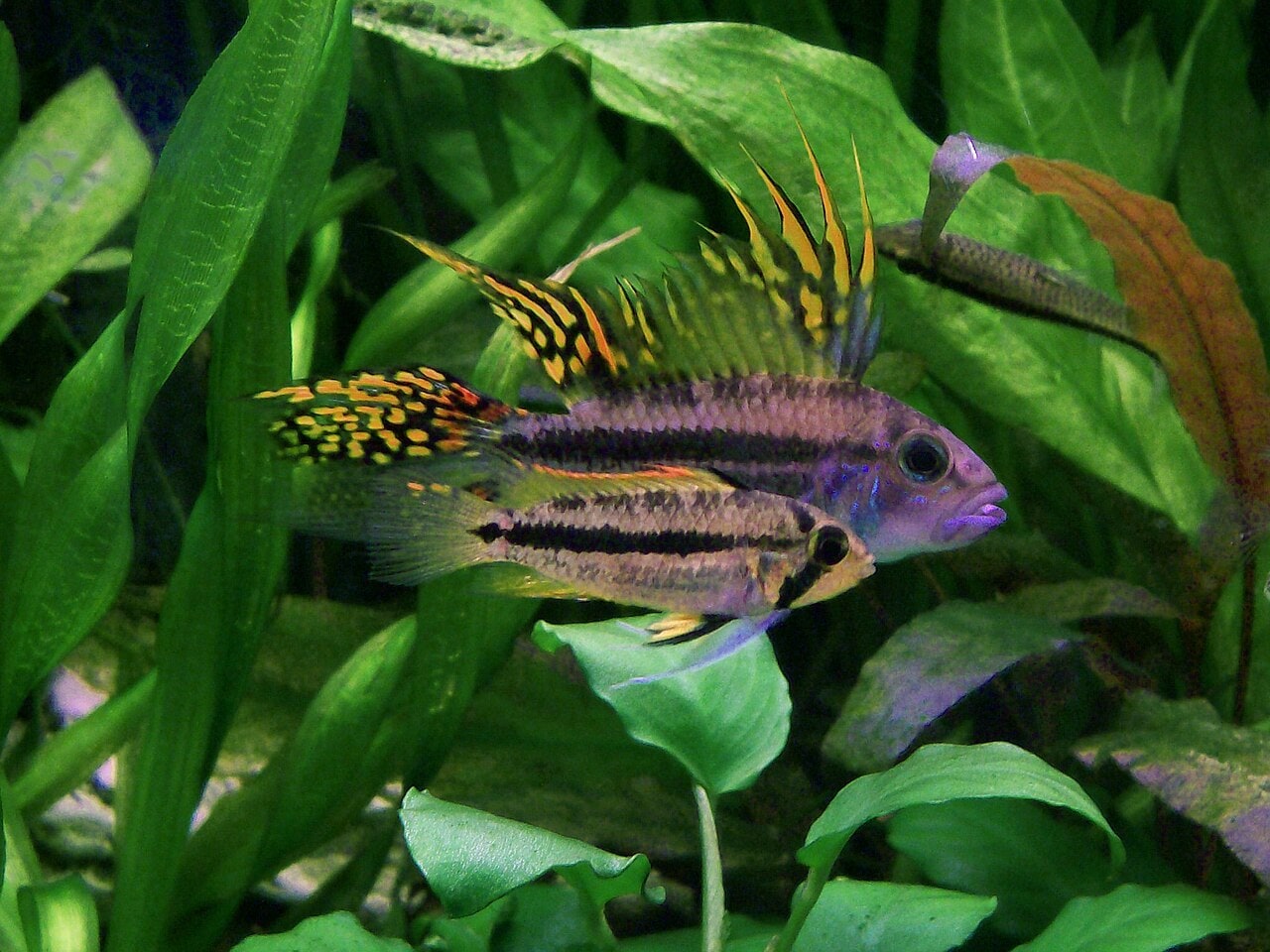
Apistogramma cacatuoides
Also known as: cockatoo cichlid, cockatoo dwarf cichlid, apistogramma cacatuoides
A small apistogramma with dramatic dorsal fin extensions on males. Needs soft warm water and a harem setup: one male and two or more females.
Cockatoo / crested Apistogramma tank mates · 100L tank size hub
semi-aggressive · intermediate care
Sources & confidencehigh · partially verified · beginner: caution
Checked against several solid care sources that mostly agree. Numbers here are a careful starting point. Your tap water, tank size, and habits decide the rest. How we evaluate.
Best for: Soft-water planted tanks 100L or more at 26–28 °C with harem structure and cave territories for females.
Avoid if: Hard alkaline water, temperatures below 25 °C, or only one female in a small tank.
Common mistakeHousing one male with one female in a short 60L is how keepers invent relentless harassment. Males need multiple females or a carefully managed pair with space and caves. A lonely 'show male' plus one female in a nano is a stress machine, not a breeding plan.
Top things that go wrong
- Fin-nipping risk in typical community layouts. Will nip long fins or slow fish when the school is too small, bored, or kept in a short tank.
- Mouth gap vs tiny tank mates. May eat tank mates small enough to fit the adult mouth — plan adult sizes, not shop sizes.
- Shrimp & snails. Not shrimp-safe — adults, fry, or both get eaten.
What most shops don't tell you
- 1.Myth: a single male-and-female cockatoo pair is a finished peaceful nano centrepiece. Reality: males often harass one female without a harem or serious cover — plan soft water, caves, and a proper male–female structure, not a 60L show couple Plan the husbandry before the shop impulse buy.
- 2.Predation risk scales with gape, night feeding, and crowding. 'they grew up together' is a schedule, not a law.
- 3.A male and three females in a 40L breeder with no cave per female. One female ends up dead or hidden for good.
- 4.Dropped into hard alkaline tap with no RO blend or transition plan. Most wild lines fade inside a fortnight.
- 5.Check the temperature and pH window for the line you bought. Feed varied small foods. Males get tough on other floor-dwellers once breeding starts.
About this species
Cockatoo dwarfs are South American apistogrammas with a tall sail-like male dorsal. They cave-breed in soft acidic water on a sand floor. A male holds a small harem of two or three females across the floor, and a random pair in 40L collapses to one fish.
- Apistogramma Macmasteri100L min · same group, comparable tank size
- Checkerboard cichlid100L min · same group, comparable tank size
- Kribensis100L min · same group, comparable tank size
- Bolivian Ram110L min · same group, comparable tank size
- Agassiz’s dwarf cichlid80L min · same group, comparable tank size
- Apistogramma Borellii80L min · same group, comparable tank size
- Apistogramma Trifasciata80L min · same group, comparable tank size
- German Blue Ram80L min · same group, comparable tank size
- Agassiz’s dwarf cichlidalso intermediate semi-aggressive, similar tank size
- American Flagfishalso intermediate semi-aggressive, similar tank size
- Apistogramma Borelliialso intermediate semi-aggressive, similar tank size
- Apistogramma Macmasterialso intermediate semi-aggressive, similar tank size
- Apistogramma Trifasciataalso intermediate semi-aggressive, similar tank size
- Electric Blue Acaraalso intermediate semi-aggressive, similar tank size
No reverse lookups listed yet.
Plan grid
Key limits are above. Here: pH band, swim level, bioload, and activity.
Swim zones
Care snapshot
Quick compare before you buy. Not a score of how “good” the fish is.
- Beginner ease38
- Peacefulness8
- Community fit0
- Small-tank fit54
- Hardiness54
- Energy24
Numbers are deterministic planning indices from Fishori fields — not a scientific score of your individual fish.
Example setups
Starting points only. Run the pair checker for every fish you add.
Avoid “one of everything” baskets — Cockatoo / crested Apistogramma belongs in a plan built around territory, line-of-sight breaks, and matched water chemistry.
Compatibility
Tank mates for Cockatoo / crested Apistogramma
No unconditional “safe” tank mates are listed for Cockatoo / crested Apistogramma — this shortlist has CAUTION pairings that need specific conditions and RISKY pairings to avoid. Conditional (CAUTION — read the pair page before buying): Angelfish, Betta, Chili Rasbora, Corydoras Catfish, Dwarf Gourami. Avoid (RISKY): African Cichlid, Oscar. Every name links to a live pair check — the lists are a shortlist, not a stocking plan.
Usually safer
Open a pair page with this fish as the starting point.
None listed. Use the pair checker before mixing.
Needs planning
Read the blocking rule on each pair page before experimenting.
Usually avoid
Do-not-stock combinations on conservative hobby rules.
No safe-mate list on this record yet. Use the fish index to find species with similar care, then run a pair check before you buy.
Behaviour and temperament
Cockatoo apistos are semi-aggressive dwarf cichlids that stay calmer toward midwater schoolers while leaning hard on rivals and mates near caves. A male with multiple females fails least often. Stress shows as continuous chasing when the pair plan is wrong.
What sets them off
- Small groups or boredom
- Long-finned or slow tank mates
- Bare tanks without structure
Fin nipping: Will nip long fins or slow fish when the school is too small, bored, or kept in a short tank.
Predation: May eat tank mates small enough to fit the adult mouth — plan adult sizes, not shop sizes.
Territory: Holds a patch (cave, corner, or surface). Break sight lines so neighbours can pass.
Planted tanks: good — easy plant ideas
In the glass: typical and warning signs
- A crested male holds caves and displays while females work leaf litter.
- Spawn defence near the cave is normal ownership, not instant tank failure.
- A battered single female usually means the harem or footprint failed.
- Washed-out colour in hard alkaline water often means chemistry first.
- Males harass lone females and rival males in sight of the same caves.
- Peaceful dither can be pushed off the bottom during spawning.
- Add females or rehome the male if harassment will not settle.
- Break sight lines before the female stops eating.
Fish behaviour can vary between individuals and tank setups. Always observe new fish closely after introduction.
Water, food, and grouping
Hardness
soft
Diet
carnivore
Cockatoo apistos are small carnivore dwarf cichlids that take frozen foods and fine sinking pellets near caves in softish warm water. Midwater flake that never reaches the sand leaves them thin. Feed after lights soften, confirm the harem reaches food under leaf litter, and keep chemistry in the band they colour up in.
Shrimp & snails
Not shrimp-safe — adults, fry, or both get eaten.
Cockatoo / crested Apistogramma is fine singly or as a researched pair — check behaviour before doubling up.
- Hold 24 to 30 °C steadily on a real thermometer, not the dial on the heater.
- Aim for pH 4.5 to 7 and a hardness you can re-test in two weeks. A one-time strip in the shop car park is not a water test.
- Footprint: short wide tanks and tall narrow tanks fish differently for the same volume. Match the tank shape to the swim pattern, not just the litre count.
- Tank volume meets or exceeds 100L published minimum for adults.
- Heater can hold 24–30°C without cooking cooler-water tank mates.
- No known fin-nippers paired with long-finned fish unless you accept documented risk.
- No tank mates small enough to fit the adult mouth gap for this species.
Explore and stocking hubs
Tank-mates hub, matching guides, category peers, and litre stocking lists around this species’ minimum tank.
Plan with tools
Check mates as pairs first, then add this fish in the tank builder for the full stocking.
Filtration & heating
A 100L minimum tank needs a filter rated for at least 400L/hr turnover and a heater to hold 24–30°C reliably.
Plant suggestions
Cockatoo / crested Apistogramma does well in planted tanks. Plants compatible with 24–30°C and pH 4.5–7:
Research: partially verified · Confidence: high · 3 linked source(s). We do not invent citations.
How Fishori evaluates compatibility (same logic as pair and tank tools).
- Seriously Fish. Apistogramma cacatuoides
Primary: aquarium size, water chemistry, behaviour, and compatibility (URL verified in upgrade script; recheck if site content changes).
- FishBase. Apistogramma cacatuoides
Secondary: taxonomy, distribution, and maximum length in nature; cross-check with aquarium import lines and measured tank parameters.
- Wikipedia. Apistogramma cacatuoides
Secondary: general species context; verify all husbandry numbers against a dedicated aquarium care sheet and your test kit, not a single table row.
Evidence notes
- The Seriously Fish profile for the binomial in this record was successfully reached as the primary aquarium reference.
- FishBase contributes natural-range size and habitat context. Translate those numbers through your heater, your water report, and your tank footprint before stocking.
- Wikipedia is only cited if the article URL returned OK. Use it for orientation, not as the only care sheet for an import.
- All compatibility text reflects typical hobby experience and the Fishori model. Individual fish, shop stress, and the order tank mates are added in can still defy a single-paragraph label.
Common questions about Cockatoo / crested Apistogramma
- How big do Cockatoo / crested Apistogramma get?
- Cockatoo / crested Apistogramma adults reach about 7 cm. Shop fish look smaller; stock for the adult length.
- What size tank does Cockatoo / crested Apistogramma need?
- 100L is the planning floor for adult swimming space and bioload. A 122L+ tank is the more comfortable long-term footprint. Length and depth matter as much as raw litres for active or territorial fish.
- Are Cockatoo / crested Apistogramma aggressive?
- Cockatoo apistos are semi-aggressive dwarf cichlids that stay calmer toward midwater schoolers while leaning hard on rivals and mates near caves. A male with multiple females fails least often. Stress shows as continuous chasing when the pair plan is wrong.
- What is the most common mistake with Cockatoo / crested Apistogramma?
- Housing one male with one female in a short 60L is how keepers invent relentless harassment. Males need multiple females or a carefully managed pair with space and caves. A lonely 'show male' plus one female in a nano is a stress machine, not a breeding plan.
- What fish can live with Cockatoo / crested Apistogramma?
- This profile currently has no curated unconditional safe-mates shortlist for Cockatoo / crested Apistogramma. Other species may still return GOOD in the pair checker, so check the exact pair rather than treating this shortlist as exhaustive. Angelfish, Betta, Chili Rasbora, Corydoras Catfish are conditional (CAUTION): workable only with the specific conditions on each pair page. Avoid African Cichlid, Oscar (RISKY). Run the pair checker for your exact water and tank size before stocking.