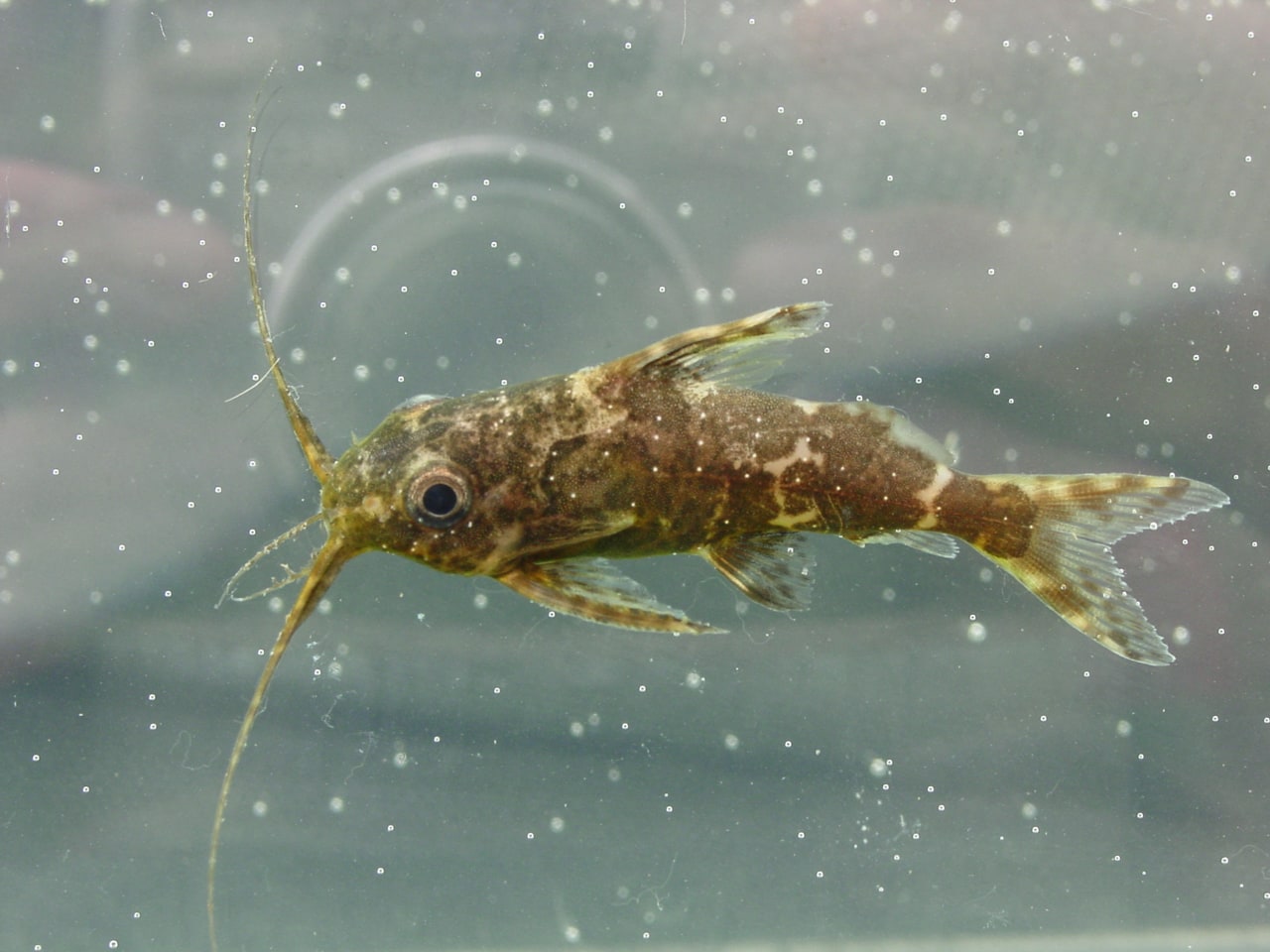
Should I buy it?
Upside-down Catfish
Synodontis nigriventris
Also known as: upside down catfish
Yes, it genuinely swims upside down, and no, that is not a problem to fix — the belly-up glide along the underside of a leaf is the species. What goes wrong is everything around it: bought singly, kept under bright bare surfaces, then reported missing for months at a time.
Upside-down Catfish tank mates · 100L tank size hub
peaceful · intermediate care
Sources & confidencehigh · partially verified · beginner: good
Checked against several solid care sources that mostly agree. Numbers here are a careful starting point. Your tap water, tank size, and habits decide the rest. How we evaluate.
Best for: Communities of 100L or more with a real roof — broad floating plants or wide overhangs — and a group of four working the underside while congo tetras hold the open water.
Avoid if: You want a fish you will see at three in the afternoon, your surface is bare glass, or the budget stretches to only one.
Common mistakeBuying a single upside-down catfish as a curiosity is how keepers invent a “shy” species. One fish hides in a cave all day and never shows the posture that made you buy it. Plan for three or more in roughly 100 litres with floating plants or overhangs so they have an underside to work. Under-stocking and bare bright glass erase the behaviour people then blame on the fish.
Top things that go wrong
- Shrimp & snails. Cherry shrimp and other dwarfs can coexist with peaceful small fish; baby shrimp are food for almost anything that finds them.
What most shops don't tell you
- 1.Shops often sell these as a lone oddball that will clean the glass while swimming upside down for entertainment. They are social nocturnal catfish, not a solo display pet, and they will not replace a real algae plan. One fish in a bright open tank is a hiding story, not a show. Buy a small group for dusk feeding under cover, or pick a different bottom fish.
- 2.Bought as a single curiosity. A solo upside-down hides in a cave all day and rarely flips in the open.
- 3.Kept in a bare bright tank. Without floating plants or overhangs, they have no underside to swim against in the natural posture.
- 4.The inverted swim is the natural posture, not a sick fish. New keepers panic the first time they see one resting belly-up under a ledge or grazing the underside of a floating leaf. The fish is fine. Add floating plants and dim cover to give the school somewhere to invert.
About this species
Upside-down catfish swim and rest belly-up under floating plants. The inverted posture is normal. Gentle for the genus but needs a group of four.
- Bronze corydoras100L min · same group, comparable tank size
- Sterba's Corydoras100L min · same group, comparable tank size
- Adolfoi cory80L min · same group, comparable tank size
- Emerald catfish (Brochis)120L min · same group, comparable tank size
- Glass Catfish80L min · same group, comparable tank size
- Peppered Corydoras80L min · same group, comparable tank size
- Corydoras Catfish60L min · same fish family
- Julii Corydoras60L min · same fish family
- Adolfoi coryalso intermediate peaceful, similar tank size
- African freshwater butterflyfishalso intermediate peaceful, similar tank size
- Bamboo Shrimpalso intermediate peaceful, similar tank size
- Black ruby barbalso intermediate peaceful, similar tank size
- Boesemani Rainbowfishalso intermediate peaceful, similar tank size
- Bolivian Ramalso intermediate peaceful, similar tank size
No reverse lookups listed yet.
Plan grid
Key limits are above. Here: pH band, swim level, bioload, and activity.
Swim zones
Care snapshot
Quick compare before you buy. Not a score of how “good” the fish is.
- Beginner ease56
- Peacefulness90
- Community fit79
- Small-tank fit54
- Hardiness54
- Energy24
Numbers are deterministic planning indices from Fishori fields — not a scientific score of your individual fish.
Example setups
Starting points only. Run the pair checker for every fish you add.
Rough 100L+ layout: one calm centrepiece, 8–12 small tetras/rasboras, 6–8 corydoras-type bottom fish — verify every name in the pair checker before buying.
Safer directions include: Boesemani Rainbowfish, Congo Tetra, Dwarf Gourami.
Compatibility
Tank mates for Upside-down Catfish
Usually safer (engine GOOD): Boesemani Rainbowfish, Congo Tetra, Dwarf Gourami. Conditional (CAUTION — read the pair page before buying): Betta, Corydoras Catfish. Avoid (RISKY): Jack Dempsey, Oscar. Every name links to a live pair check — the lists are a shortlist, not a stocking plan.
Usually safer
Open a pair page with this fish as the starting point.
Needs planning
Read the blocking rule on each pair page before experimenting.
Usually avoid
Do-not-stock combinations on conservative hobby rules.
Compare with
Run a real pair check: Upside-down Catfish + Boesemani Rainbowfish
Behaviour and temperament
Upside-down catfish read cover and flow more than a peaceful label. A solo fish parks under the filter and almost never flips in the open; three or four share the underside line and the inverted swim becomes normal evening traffic. Daylight hiding is ordinary for Synodontis nigriventris, not illness. Stillness with clamped fins after a move is the odd signal — check water before you assume temperament failed.
What sets them off
- Sudden crowding
- Poor water quality
Fin nipping: Not a habitual fin-nipper; stressed or crowded individuals can still test fins.
Predation: Not a predator toward similarly sized community fish; fry and dwarf shrimp are still fair game for most species.
Territory: Not strongly territorial, but still needs room so its working space does not overlap the next fish.
Planted tanks: excellent — easy plant ideas
In the glass: typical and warning signs
- Groups of three or more work the underside of floating plants after dark; singles vanish under hardware.
- Daylight resting in cover is normal Synodontis rhythm, not chronic stress by itself.
- Clamped fins and refusal to flip after a move — test water before blaming tank mates.
- Bright bare tanks with no overhangs leave them with nowhere to swim inverted.
- In-group jostling at food is common; they are not a fin-nipping community pest.
- One fish never seen for weeks → add companions and cover, or rehome the solo plan.
Fish behaviour can vary between individuals and tank setups. Always observe new fish closely after introduction.
Water, food, and grouping
Hardness
medium
Diet
omnivore
They hunt the surface film and underside of floating cover after lights soften, so wafers dumped on bare sand often sit untouched. Swirl a little sinking food or frozen under floating plants at dusk and watch the group flip to feed. A protein rotation a few times a week keeps condition on fish you barely see by day. If only midwater fish look fat, you are feeding the wrong plane of the tank.
Shrimp & snails
Cherry shrimp and other dwarfs can coexist with peaceful small fish; baby shrimp are food for almost anything that finds them.
Schooling species — buy 4+ together. Smaller groups stress and lose colour.
- Hold 24 to 28 °C steadily on a real thermometer, not the dial on the heater.
- Aim for pH 6 to 7.5 and a hardness you can re-test in two weeks. A one-time strip in the shop car park is not a water test.
- Schooling species. Buy 4 or more from the same tank on the same day before adding any centrepiece fish.
- Tank volume meets or exceeds 100L published minimum for adults.
- You can stock at least 4 individuals (group welfare).
- Heater can hold 24–28°C without cooking cooler-water tank mates.
Explore and stocking hubs
Tank-mates hub, matching guides, category peers, and litre stocking lists around this species’ minimum tank.
Plan with tools
Check mates as pairs first, then add this fish in the tank builder for the full stocking.
Filtration & heating
A 100L minimum tank needs a filter rated for at least 400L/hr turnover and a heater to hold 24–28°C reliably.
Plant suggestions
Upside-down Catfish does well in planted tanks. Plants compatible with 24–28°C and pH 6–7.5:
Research: partially verified · Confidence: high · 3 linked source(s). We do not invent citations.
How Fishori evaluates compatibility (same logic as pair and tank tools).
- Seriously Fish. Synodontis nigriventris
Supports: aquarium size, water chemistry, temperament and compatibility (primary care reference).
- FishBase. Synodontis nigriventris
Supports: taxonomy and wild maximum size — translate to tank stocking, not a target number.
- Wikipedia. Synodontis nigriventris
Supports: general species background and common-name orientation only.
Evidence notes
- Care numbers are cross-checked across the linked sources and biased toward the conservative end; compatibility reflects typical hobby experience, not a lab prediction. Method and full source policy: /methodology.
Common questions about Upside-down Catfish
- How big do Upside-down Catfish get?
- Upside-down Catfish adults reach about 10 cm. Shop fish look smaller; stock for the adult length.
- What size tank does Upside-down Catfish need?
- 100L is the planning floor for adult swimming space and bioload. A 122L+ tank is the more comfortable long-term footprint. Length and depth matter as much as raw litres for active or territorial fish.
- Are Upside-down Catfish aggressive?
- Upside-down catfish read cover and flow more than a peaceful label. A solo fish parks under the filter and almost never flips in the open; three or four share the underside line and the inverted swim becomes normal evening traffic. Daylight hiding is ordinary for Synodontis nigriventris, not illness. Stillness with clamped fins after a move is the odd signal — check water before you assume temperament failed.
- Do Upside-down Catfish need to be kept in a group?
- Schooling species — buy 4+ together. Smaller groups stress and lose colour.
- What is the most common mistake with Upside-down Catfish?
- Buying a single upside-down catfish as a curiosity is how keepers invent a “shy” species. One fish hides in a cave all day and never shows the posture that made you buy it. Plan for three or more in roughly 100 litres with floating plants or overhangs so they have an underside to work. Under-stocking and bare bright glass erase the behaviour people then blame on the fish.
- What fish can live with Upside-down Catfish?
- The Upside-down Catfish profile lists Boesemani Rainbowfish, Congo Tetra, Dwarf Gourami among its safer pairings (engine-checked GOOD). Betta, Corydoras Catfish are conditional (CAUTION): workable only with the specific conditions on each pair page. Avoid Jack Dempsey, Oscar (RISKY). Run the pair checker for your exact water and tank size before stocking.