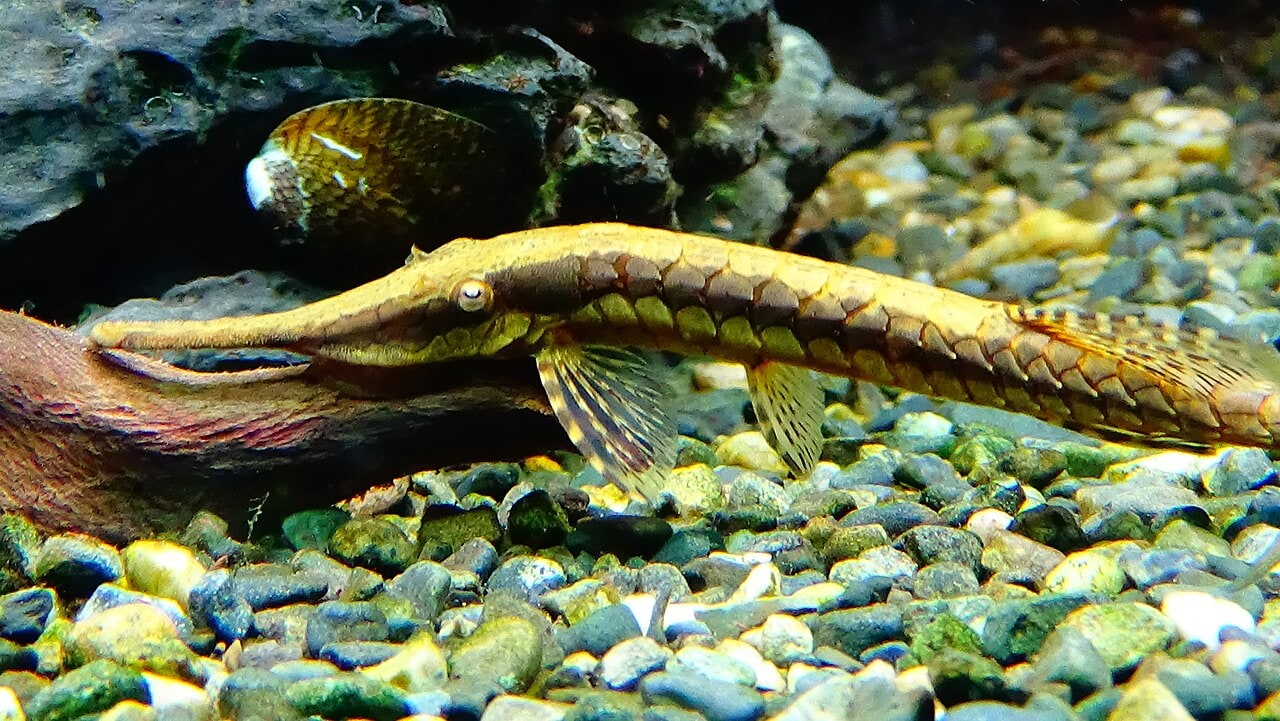
Should I buy it?
Twig / whiptail catfish
Farlowella acus
Also known as: whiptail catfish, twig catfish, Whiptail (many Farlowella spp. in trade; verify with supplier)
A remarkable stick-like algae grazer that needs a consistent algae supply and is sensitive to water quality. Often miscategorised as easy.
Twig / whiptail catfish tank mates · 160L tank size hub
peaceful · intermediate care
Sources & confidencemedium · partially verified · beginner: caution
Typical care sources — trade names for this fish get mixed up, so verify the ID before you buy. Numbers here are a careful starting point. Your tap water, tank size, and habits decide the rest. How we evaluate.
Best for: Mature planted tanks 150L or more with consistent algae supply, daily vegetable supplementation, and peaceful companions.
Avoid if: Your tank is under six months old, lacks adequate algae for continuous grazing, or has aggressive fish.
Common mistakeExpecting twig catfish to live on tank algae alone is how keepers invent slow starvation that looks like camouflage success. Supplement vegetables and wafers from day one. Mature planted cover and gentle neighbours matter more than a 'cleanup crew' sales pitch.
Top things that go wrong
- Shrimp & snails. Cherry shrimp and other dwarfs can coexist with peaceful small fish; baby shrimp are food for almost anything that finds them.
Common trade-name warning
This fish is often sold under different names or species variants. Care guidance is based on typical aquarium examples rather than a single exact species. Whiptails in shops may be several Farlowella or Sturisoma species; long-snout care is similar, but not every "twig" is F. acus without a positive ID.
What most shops don't tell you
- 1.Myth: twig catfish are easy algae-only cleanup fish for any community nano tank. Reality: they need mature biofilm, vegetable supplements, and calm company — algae alone in a spotless tank starves them quietly while they still look ornamental on the wood.
- 2.Sold as a fast-growing algae cleaner for a new tank. The fish starves before the algae arrives.
- 3.Kept in small tanks with fast midwater fish. The twig loses every meal at the glass and slowly thins.
- 4.Long snout/whiptail: watch for nipped tips and damaged barbels. Feed fibre-rich, slow-sinking, and periphyton-appropriate diet once settled (not 'just algae').
About this species
Twig catfish are 20 cm Farlowella that look exactly like a stick of waterlogged wood. Needs fine sand, mature wood biofilm, and a quiet low-competition community. Starves in a bare bright tank with sharp gravel and fast midwater fish.
- Emerald catfish (Brochis)120L min · same group, comparable tank size
- Bronze corydoras100L min · same fish family
- Cuckoo / petricola catfish200L min · same fish family
- Sterba's Corydoras100L min · same fish family
- Upside-down Catfish100L min · same fish family
- Adolfoi cory80L min · same fish family
- Glass Catfish80L min · same fish family
- Peppered Corydoras80L min · same fish family
- Adolfoi coryalso intermediate peaceful, similar tank size
- African freshwater butterflyfishalso intermediate peaceful, similar tank size
- Bamboo Shrimpalso intermediate peaceful, similar tank size
- Black ruby barbalso intermediate peaceful, similar tank size
- Boesemani Rainbowfishalso intermediate peaceful, similar tank size
- Bolivian Ramalso intermediate peaceful, similar tank size
No reverse lookups listed yet.
Plan grid
Key limits are above. Here: pH band, swim level, bioload, and activity.
Swim zones
Care snapshot
Quick compare before you buy. Not a score of how “good” the fish is.
- Beginner ease32
- Peacefulness82
- Community fit59
- Small-tank fit42
- Hardiness54
- Energy24
Numbers are deterministic planning indices from Fishori fields — not a scientific score of your individual fish.
Example setups
Starting points only. Run the pair checker for every fish you add.
Avoid “one of everything” baskets — Twig / whiptail catfish belongs in a plan built around territory, line-of-sight breaks, and matched water chemistry.
Compatibility
Tank mates for Twig / whiptail catfish
No unconditional “safe” tank mates are listed for Twig / whiptail catfish — this shortlist has CAUTION pairings that need specific conditions and RISKY pairings to avoid. Conditional (CAUTION — read the pair page before buying): Bala / silver shark, Boesemani Rainbowfish, Corydoras Catfish, Dwarf Gourami, Ember Tetra. Avoid (RISKY): African Cichlid, Oscar. Every name links to a live pair check — the lists are a shortlist, not a stocking plan.
Usually safer
Open a pair page with this fish as the starting point.
None listed. Use the pair checker before mixing.
Needs planning
Read the blocking rule on each pair page before experimenting.
Usually avoid
Do-not-stock combinations on conservative hobby rules.
No safe-mate list on this record yet. Use the fish index to find species with similar care, then run a pair check before you buy.
Behaviour and temperament
Twig catfish are peaceful and retiring toward fish when left alone. They do not defend territory. Stress shows as weight loss, clamped posture, and constant hiding when food never arrives or when boisterous midwater fish outcompete them at every feed.
What sets them off
- Sudden crowding
- Poor water quality
Fin nipping: Not a habitual fin-nipper; stressed or crowded individuals can still test fins.
Predation: Not a predator toward similarly sized community fish; fry and dwarf shrimp are still fair game for most species.
Territory: Holds a patch (cave, corner, or surface). Break sight lines so neighbours can pass.
Planted tanks: excellent — easy plant ideas
In the glass: typical and warning signs
- A twig rests along wood or stems and rasps biofilm in a mature dim tank.
- Slow deliberate movement along décor is normal ownership — not laziness alone.
- A thinning body with closed mouth usually means diet and competition failed first.
- Chronic hiding under boisterous feeders means feeding time and neighbours failed.
- No malice toward tank mates; they are the ones at risk from aggressive fish.
- Crowded hungry communities steal every wafer before the twig reaches it.
- Feed sinking foods after lights soften before adding another shy bottom species.
- Remove hyper competitors if the twig never reaches food.
Fish behaviour can vary between individuals and tank setups. Always observe new fish closely after introduction.
Water, food, and grouping
Hardness
soft
Diet
omnivore
Twig catfish are shy wood-associated omnivores that need biofilm, sinking wafers, and regular vegetable supplementation — not algae alone on bare glass. Feed after lights soften so they reach food without competition, keep mature water, and expect slow, deliberate grazing along stems and wood. A thin Farlowella is usually a feeding failure, not a mystery disease.
Shrimp & snails
Cherry shrimp and other dwarfs can coexist with peaceful small fish; baby shrimp are food for almost anything that finds them.
Twig / whiptail catfish is fine singly or as a researched pair — check behaviour before doubling up.
- Hold 24 to 28 °C steadily on a real thermometer, not the dial on the heater.
- Aim for pH 6 to 7.2 and a hardness you can re-test in two weeks. A one-time strip in the shop car park is not a water test.
- Footprint: short wide tanks and tall narrow tanks fish differently for the same volume. Match the tank shape to the swim pattern, not just the litre count.
- Tank volume meets or exceeds 150L published minimum for adults.
- Heater can hold 24–28°C without cooking cooler-water tank mates.
- No known fin-nippers paired with long-finned fish unless you accept documented risk.
Explore and stocking hubs
Tank-mates hub, matching guides, category peers, and litre stocking lists around this species’ minimum tank.
Plan with tools
Check mates as pairs first, then add this fish in the tank builder for the full stocking.
Filtration & heating
A 150L minimum tank needs a filter rated for at least 600L/hr turnover and a heater to hold 24–28°C reliably.
Plant suggestions
Twig / whiptail catfish does well in planted tanks. Plants compatible with 24–28°C and pH 6–7.2:
Research: partially verified · Confidence: medium · 3 linked source(s). We do not invent citations.
How Fishori evaluates compatibility (same logic as pair and tank tools).
- LiveAquaria. Farlowella (twig / whiptail) catfish
Primary: retailer care page specifically titled Farlowella acus: tank size, planted tank use, and feeding when algae is scarce. Trade whiptails are often mixed Farlowella/Sturisoma; confirm snout/head profile from photos, not a single common name.
- Planet Catfish. Farlowella acus (Cat-eLog species sheet)
Primary: hobby data sheet: identification, long-snout care, and typical failure modes (outcompeted, wrong substrate) for this loricariid type.
- FishBase. Farlowella acus
Secondary: taxonomy, distribution, and maximum length in nature; cross-check with aquarium import lines and measured tank parameters.
Evidence notes
- Seriously Fish did not serve a retrievable F. acus profile URL. Retail pages + Planet Catfish are used instead, but the trade label 'whiptail / farlowella' is shared across similar species, so a perfect one-species public page is still rare; identify the import before mirroring pH/length to the letter.
- FishBase contributes natural-range size and habitat context. Translate those numbers through your heater, your water report, and your tank footprint before stocking.
- All compatibility text reflects typical hobby experience and the Fishori model. Individual fish, shop stress, and the order tank mates are added in can still defy a single-paragraph label.
Common questions about Twig / whiptail catfish
- How big do Twig / whiptail catfish get?
- Twig / whiptail catfish adults reach about 20 cm. Shop fish look smaller; stock for the adult length.
- What size tank does Twig / whiptail catfish need?
- 150L is the planning floor for adult swimming space and bioload. A 183L+ tank is the more comfortable long-term footprint. Length and depth matter as much as raw litres for active or territorial fish.
- Are Twig / whiptail catfish aggressive?
- Twig catfish are peaceful and retiring toward fish when left alone. They do not defend territory. Stress shows as weight loss, clamped posture, and constant hiding when food never arrives or when boisterous midwater fish outcompete them at every feed.
- What is the most common mistake with Twig / whiptail catfish?
- Expecting twig catfish to live on tank algae alone is how keepers invent slow starvation that looks like camouflage success. Supplement vegetables and wafers from day one. Mature planted cover and gentle neighbours matter more than a 'cleanup crew' sales pitch.
- What fish can live with Twig / whiptail catfish?
- This profile currently has no curated unconditional safe-mates shortlist for Twig / whiptail catfish. Other species may still return GOOD in the pair checker, so check the exact pair rather than treating this shortlist as exhaustive. Bala / silver shark, Boesemani Rainbowfish, Corydoras Catfish, Dwarf Gourami are conditional (CAUTION): workable only with the specific conditions on each pair page. Avoid African Cichlid, Oscar (RISKY). Run the pair checker for your exact water and tank size before stocking.