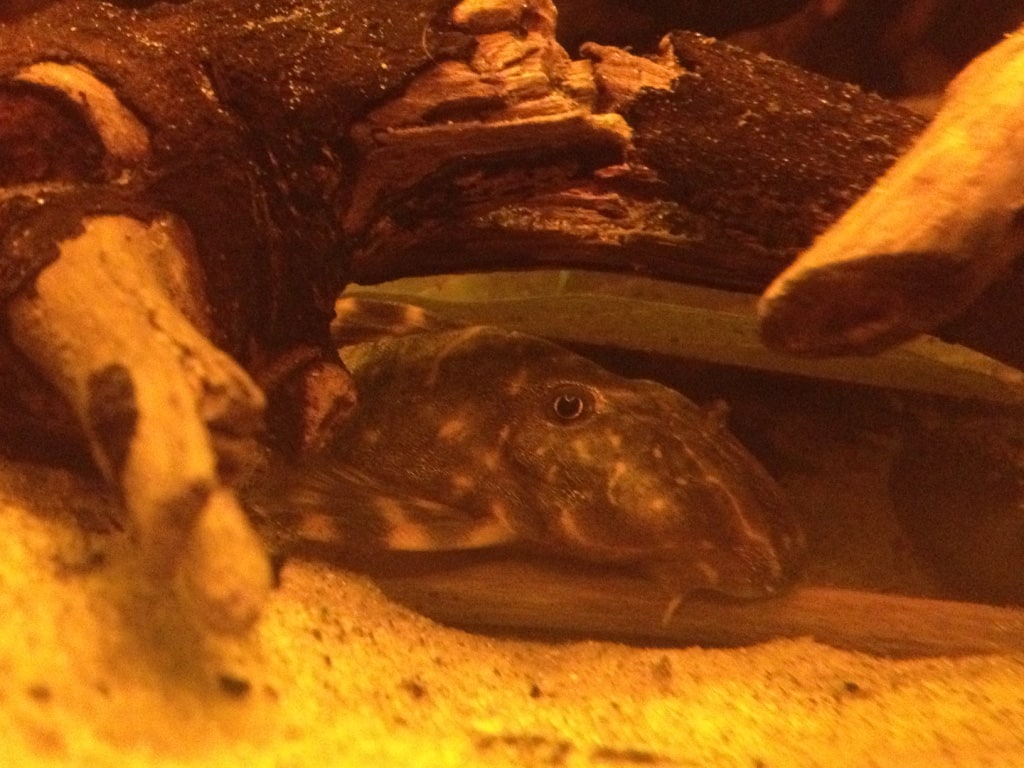
Should I buy it?
Clown Pleco
Panaqolus maccus
Also known as: clown panaque, l104
A 9 cm pleco that eats wood, not algae. Buy it as a small, tough bottom fish with a driftwood diet — anyone expecting clean glass has bought the wrong animal.
Clown Pleco tank mates · 120L tank size hub
peaceful · intermediate care
Sources & confidencemedium · partially verified · beginner: caution
Typical care sources — real tanks still vary. Numbers here are a careful starting point. Your tap water, tank size, and habits decide the rest. How we evaluate.
Best for: Planted tanks of 110L or more with real driftwood stacked into caves, where a low-key bottom fish is wanted and algae control is nobody's job.
Avoid if: There is no driftwood in the tank and none planned, or you wanted visible daytime activity — clowns spend most of it wedged under the wood.
Common mistakePlanning for clean glass and forgetting driftwood is the mistake that defines poor clown-pleco ownership. They are bought as algae eaters but often ignore algae entirely once established, so the tank needs wood and deliberate night feeding rather than a cleanup fantasy. Put the wood in before the fish arrives. Waiting until condition slips is harder to reverse than starting with the right furniture.
Top things that go wrong
- Shrimp & snails. Cherry shrimp and other dwarfs can coexist with peaceful small fish; baby shrimp are food for almost anything that finds them.
What most shops don't tell you
- 1.The shop story is usually that a small striped pleco will keep the aquarium tidy. Clown Plecos are a small, tough bottom fish with a wood-based diet, not a substitute for algae management. If the glass stays green, that does not mean the fish failed — it means the sales pitch was about the wrong job. Buy them for the species you want, and handle algae with plants, light, and maintenance.
- 2.Buying a clown pleco without driftwood ready. The fish needs cellulose, not just wafers, and dies if you skip the wood.
- 3.Stocking it as a generic algae cleaner for a new tank. Clown plecos do not strip green algae, they rasp wood.
- 4.Real driftwood is the diet, not decoration. Add sinking algae and vegetable wafers at night.
- 5.Wood fibre in the diet matters long term; not a substitute for algae-only maintenance.
About this species
Small wood-eating loricariid with bold bands. Needs driftwood for fibre intake and good filtration. Not a generic algae cleaner for brand-new tanks.
- Siamese Algae Eater100L min · same group, comparable tank size
- Bristlenose Pleco80L min · same fish family
- Otocinclus60L min · same fish family
- Royal pleco500L min · same fish family
- Adolfoi coryalso intermediate peaceful, similar tank size
- African freshwater butterflyfishalso intermediate peaceful, similar tank size
- Bamboo Shrimpalso intermediate peaceful, similar tank size
- Black ruby barbalso intermediate peaceful, similar tank size
- Boesemani Rainbowfishalso intermediate peaceful, similar tank size
- Bolivian Ramalso intermediate peaceful, similar tank size
No reverse lookups listed yet.
Plan grid
Key limits are above. Here: pH band, swim level, bioload, and activity.
Swim zones
Care snapshot
Quick compare before you buy. Not a score of how “good” the fish is.
- Beginner ease32
- Peacefulness82
- Community fit66
- Small-tank fit51
- Hardiness54
- Energy24
Numbers are deterministic planning indices from Fishori fields — not a scientific score of your individual fish.
Example setups
Starting points only. Run the pair checker for every fish you add.
Rough 110L+ layout: one calm centrepiece, 8–12 small tetras/rasboras, 6–8 corydoras-type bottom fish — verify every name in the pair checker before buying.
Safer directions include: Ember Tetra, Harlequin Rasbora.
Avoid “one of everything” baskets — Clown Pleco belongs in a plan built around territory, line-of-sight breaks, and matched water chemistry.
Compatibility
Tank mates for Clown Pleco
Usually safer (engine GOOD): Ember Tetra, Harlequin Rasbora. Conditional (CAUTION — read the pair page before buying): Common Pleco, Corydoras Catfish, Neon Tetra. Avoid (RISKY): Oscar. Every name links to a live pair check — the lists are a shortlist, not a stocking plan.
Usually safer
Open a pair page with this fish as the starting point.
Needs planning
Read the blocking rule on each pair page before experimenting.
Usually avoid
Do-not-stock combinations on conservative hobby rules.
Compare with
Run a real pair check: Clown Pleco + Ember Tetra
Behaviour and temperament
Clown Plecos are often bought as algae eaters, then spend their nights rasping wood once they settle. Many keepers notice the green glass barely changes, while fine sawdust-like droppings appear on the sand when the wood diet is working. That pattern is normal ownership, not a lazy cleaner. If there is no wood dust and the fish looks thinner over months, the missing log matters more than another algae wafer.
What sets them off
- Sudden crowding
- Poor water quality
Fin nipping: Not a habitual fin-nipper; stressed or crowded individuals can still test fins.
Predation: Not a predator toward similarly sized community fish; fry and dwarf shrimp are still fair game for most species.
Territory: Holds a patch (cave, corner, or surface). Break sight lines so neighbours can pass.
Planted tanks: good — easy plant ideas
In the glass: typical and warning signs
- They often wedge under wood by day, and rasping the log at night is the real job.
- Fine sawdust droppings on the sand usually mean the wood diet is working.
- A thin belly with no wood dust often means wafers alone are not covering cellulose needs.
- Daytime pacing in a bare tank is common when there is nowhere safe to wedge.
- Mild cave disputes with other small plecos can happen; they rarely bother midwater fish.
- If two clowns shred over one log, add wood and a second cave, or split them.
- If they are your only algae crew and the glass stays green, add a real algae plan.
Fish behaviour can vary between individuals and tank setups. Always observe new fish closely after introduction.
Water, food, and grouping
Hardness
soft
Diet
herbivore
Many people buy Clown Plecos expecting them to clean algae from the glass. In reality, driftwood is an important part of their diet, and fish kept without suitable wood can slowly lose condition even if they accept prepared foods. Keep a proper piece of wood in the tank for life, and use wafers as support rather than the whole menu. The droppings are a practical check that the fish is actually eating cellulose.
Shrimp & snails
Cherry shrimp and other dwarfs can coexist with peaceful small fish; baby shrimp are food for almost anything that finds them.
Clown Pleco is fine singly or as a researched pair — check behaviour before doubling up.
- Hold 24 to 30 °C steadily on a real thermometer, not the dial on the heater.
- Aim for pH 5.5 to 7.5 and a hardness you can re-test in two weeks. A one-time strip in the shop car park is not a water test.
- Footprint: short wide tanks and tall narrow tanks fish differently for the same volume. Match the tank shape to the swim pattern, not just the litre count.
- Tank volume meets or exceeds 110L published minimum for adults.
- Heater can hold 24–30°C without cooking cooler-water tank mates.
Explore and stocking hubs
Tank-mates hub, matching guides, category peers, and litre stocking lists around this species’ minimum tank.
Plan with tools
Check mates as pairs first, then add this fish in the tank builder for the full stocking.
Filtration & heating
A 110L minimum tank needs a filter rated for at least 440L/hr turnover and a heater to hold 24–30°C reliably.
Plant suggestions
Clown Pleco does well in planted tanks. Plants compatible with 24–30°C and pH 5.5–7.5:
Research: partially verified · Confidence: medium · 2 linked source(s). We do not invent citations.
How Fishori evaluates compatibility (same logic as pair and tank tools).
- Planet Catfish. Panaqolus maccus (clown plec / L104, Cat-eLog)
Primary: hobby standard wood-eater sheet: L-number link, size, feeding, and the driftwood-dependence reality for Panaqolus maccus.
- FishBase. Panaqolus maccus
Supports: taxonomy and wild maximum size — translate to tank stocking, not a target number.
Evidence notes
- A Seriously Fish Panaqolus maccus profile was not available at a stable URL during curation; Planet Catfish is the de facto L-number hobby reference for this species and wood diet.
- Care numbers are cross-checked across the linked sources and biased toward the conservative end; compatibility reflects typical hobby experience, not a lab prediction. Method and full source policy: /methodology.
Common questions about Clown Pleco
- How big do Clown Pleco get?
- Clown Pleco adults reach about 9 cm. Shop fish look smaller; stock for the adult length.
- What size tank does Clown Pleco need?
- 110L is the planning floor for adult swimming space and bioload. A 134L+ tank is the more comfortable long-term footprint. Length and depth matter as much as raw litres for active or territorial fish.
- Are Clown Pleco aggressive?
- Clown Plecos are often bought as algae eaters, then spend their nights rasping wood once they settle. Many keepers notice the green glass barely changes, while fine sawdust-like droppings appear on the sand when the wood diet is working. That pattern is normal ownership, not a lazy cleaner. If there is no wood dust and the fish looks thinner over months, the missing log matters more than another algae wafer.
- What is the most common mistake with Clown Pleco?
- Planning for clean glass and forgetting driftwood is the mistake that defines poor clown-pleco ownership. They are bought as algae eaters but often ignore algae entirely once established, so the tank needs wood and deliberate night feeding rather than a cleanup fantasy. Put the wood in before the fish arrives. Waiting until condition slips is harder to reverse than starting with the right furniture.
- What fish can live with Clown Pleco?
- The Clown Pleco profile lists Ember Tetra, Harlequin Rasbora among its safer pairings (engine-checked GOOD). Common Pleco, Corydoras Catfish, Neon Tetra are conditional (CAUTION): workable only with the specific conditions on each pair page. Avoid Oscar (RISKY). Run the pair checker for your exact water and tank size before stocking.